

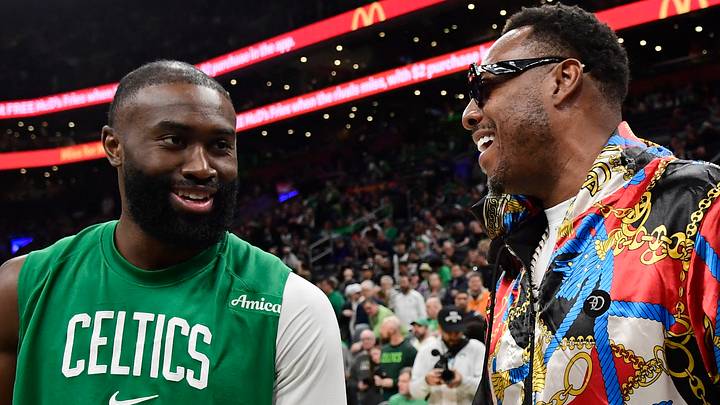
Jaylen Brown and Paul Pierce are Boston Celtics legends in their own right. They wrote their own individual legacies during their time with the team, but when they had their peak seasons, Boston responded in completely opposite ways. When Pierce peaked, they believed it was in their best interest to build around him, yet when Brown did the same, they went in the opposite direction.
In fact, it might just be how their teams fared during their best individual seasons as Celtics that pushed them to make their decisions. Let's take you back to the 2005-06 season. The Celtics weren't bad, but they certainly weren't good either. They were firmly on the line between bad and mediocre.
The only one who kept them from being among the league's worst was Pierce, who, while already a superstar, took another leap even with the limited talent around him.
His best teammates were Wally Szczerbiak (declining), Raef LaFrentz (knees were gone), Al Jefferson (wasn't ready yet), Delonte West (promising but limited ceiling), Ryan Gomes (ditto), and Kendrick Perkins (no comment). It's safe to say there was a reason why Boston wasn't that good despite Pierce's best efforts.
It was clear Boston did not think Pierce's numbers were empty calories, as two years later, they finally built a contender from there, and you probably know the rest.
Celtics clearly believed last season's success wasn't just Brown
Many thought last season was a gap year for the Celtics, with Jayson Tatum out and them losing four pieces of their championship rotation (Jrue Holiday, Kristaps Porzingis, Al Horford, Luke Kornet). But that wasn't the case.
They stumbled at the starting line, but alongside a career year from Brown, the team featured Derrick White (DPOY candidate), Payton Pritchard (thrived as a starter), Neemias Queta (MIP candidate), Sam Hauser, Hugo Gonzalez (NBA-ready rookie), Baylor Scheierman (NBA-ready sophomore), and Luka Garza (fan favorite) gave Boston a surprisingly resilient team.
(It's a shame I couldn't include Anfernee Simons only because he didn't last the season)
It can be true that both Brown led the charge on an excellent season and that the team itself turned out to be demonstrably better as a whole than we thought regardless of how he played. Because of that, they may have thought trading him wouldn't be such a detriment, especially with healthier Tatum, Paul George, Mitchell Robinson, and Mike Conley Jr. all joining the team.
No one is trying to disparage Brown's last season as a Celtic. His play was as awesome as it was unforgettable, but anyone with eyes can see that Pierce putting up similar MVP-like numbers on a substantially worse Celtics team 20 years prior is proof that anyone can play at that level and their team can still be bad.
This isn't meant to open up a Pierce vs. Brown debate, but substitute Brown for Pierce on that team, and at best, the final result doesn't change. There's no telling how Pierce would have done on last year's Celtics team, but the results would indicate that the Celtics feel their success last year was team-driven, not Brown-drive.
The overall team success may not have pushed Boston to trade Brown, but it may have factored into their rationale for pulling the trigger.
 Add us as a preferred source on Google