

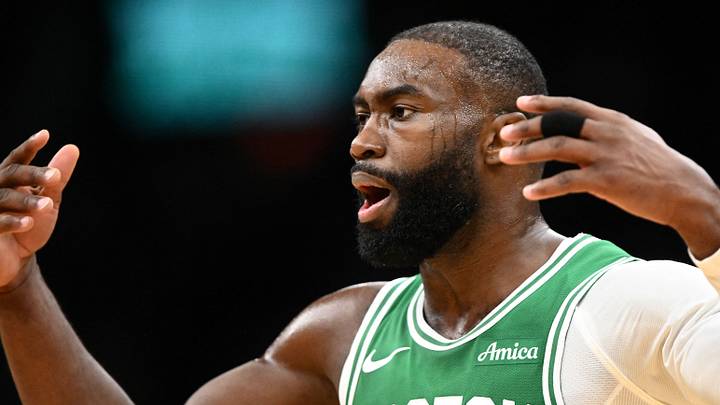
Brad Stevens and Bill Chisholm faced the music head-on at Monday's press conference. Five days after the Boston Celtics sent Jaylen Brown to the Philadelphia 76ers for Paul George and draft capital, it was time to explain why.
Previous reporting addressed that as well as possible. And there was no oath before the two stepped onto the Auerbach Center podium. It was still a nearly-hour-long media availability that should make clear what did and did not drive this controversial decision.
As Stevens explained, what pushed the Celtics to end one of the most successful eras in franchise history was a pivot in how best to operate under this unforgiving collective bargaining agreement.
Punitive CBA and a change in usage rate drove Celtics' Jaylen Brown trade
The first half of that equation is designed to promote parity. It does so without sympathy for a homegrown star and fan favorite.
"The new CBA coincided with seven years after the supermaxes were instituted," stated Stevens. "We may not be sitting here if there was a rule in the CBA that said, 'The guys that you drafted that you signed for 35 percent supermaxes count as 25 percent of the cap."
That would have given Boston and teams around the Association more flexibility in building their roster. It also helps efforts to account for more than just the upcoming campaign.
As the Celtics' president of basketball operations highlighted, when the franchise captured Banner 18 in 2023-24, Jayson Tatum and Jaylen Brown led them there while accounting for 47 percent of the cap. That number's going up while the NBA is historically expensive relative to the tax.
It's not just a product of the new extension rules that Stevens mentioned. The cap hasn't risen by its typical 10 percent projection. A sharp decline in local TV revenue has a great deal to do with that.
The result is a squeeze that played a leading role in Boston trading a beloved son.
The Celtics are betting on strength in numbers
Along with reconfiguring their cap sheet, there's the desire to be more equitable with the team's usage rate.
"The path looked a little bit more challenging to me," conveyed Stevens. "I might be wrong. I'm not going to stand up here and be defensive about that, but the path looked a little bit more challenging with 70 percent of our cap and such a high percent of our usage tied into two players."
Instead, they will empower Payton Pritchard. They believe in a new direction centered around accentuating Tatum and strength in numbers. For players like Hugo Gonzalez, Baylor Scheierman, and Jordan Walsh to grow, they need the appropriate opportunities. Furthermore, Derrick White's track record suggests betting on him to recapture his shooting rhythm.
While it may be another sign that teams are putting too much stock in certain analytics, even with the veteran guard not performing up to par in that area, during a regular-season trip to Cleveland, Cavaliers head coach Kenny Atkinson declared him a top-five player in the league.
Imagine his impact if he sustains playing at an All-Defensive First Team standard while returning to being a knockdown shooter? White's pairing that with everything else he provides would go a long way toward Boston maximizing this new approach.
"We're excited about Paul. We're excited about a lot of our young guys, we're excited about the depth of our group, we're excited about our very best players, and we are, we think we've got a good team, and we think we've got a lot of options moving forward," said Stevens.
That includes the potential for their added draft capital to help the Celtics reel in a big fish. There is optimism about this new direction, but more importantly, there's the flexibility to adapt if they must find a new star running mate for Tatum.
Why did the Celtics agree to trade Jaylen Brown to a rival at the start of free agency?
On Jul. 1, news of this blockbuster deal broke just before 6:15 PM on the East Coast. It was a seismic move, signed off on in the infancy of free agency.
So, why didn't Boston wait? Why not hold out to see if any team, especially one that's not a conference rival, one you may have to go through repeatedly in the playoffs in the near future, would beat this offer?
"Obviously, this was not a secret, so people had plenty of information, or at least had a reason to make offers, make a run, whatever the case may be," noted Stevens. "The one thing that I will say is we tried our very best to -- look, and again, assess -- not necessarily -- we tried to really assess the value of what we thought a pick was worth, or, at least best predict it."
Perhaps patience would have played out in their favor. They felt they had enough intel to suggest otherwise. And while one can point the finger in their direction, not only is it a move they're comfortable with, but other organizations had the chance to acquire Brown for equal value. The Celtics would have been delighted to send him in many directions other than Philadelphia.
"The Philly part, I'm with you, that is a hard thing to trade a guy that you, first of all, care so much about, secondly, have so much respect and admiration for, to a team that just beat you in the playoffs, and that you're going to literally play six times before the playoffs next year with our two preseason games," acknowledged Stevens.
"But I do think that, ultimately, when you do a deal, you have to be thinking about you first and the optionality it creates for you. If I was being honest, if that exact deal came from a team out West and you were comparing the two, then you probably pick the team out West, but that's not the way it would work."
The Celtics weren't driven by ownership to trade Jaylen Brown
That concern, and the outcry surrounding it, never held water, in this author's opinion. George's contract, which includes a player option for next season, is one year shorter than Brown's. However, while they're on the books, the money is nearly even.
Even the idea of George getting salary-dumped next offseason, in exchange for a return absorbing significantly less of Boston's salary cap, is hard to envision under this collective bargaining agreement.
When the Celtics' lead owner and governor fielded questions, he made it abundantly clear that the motivation for trading their star wing wasn't to shed payroll to benefit him and his partners. There is only one mandate coming from the top.
Bill Chisholm says that ownership gave NO directive to cut costs.
— Celtics on CLNS (@CelticsCLNS) July 6, 2026
"This was all about trying to win...I think we have the best front office in the NBA. They put in their work and they came to the conclusion this was the best way for us to win.
-@CLNSMedia Q: @AngelSalcedoTV pic.twitter.com/LVRWEV06nV
"No, absolutely not," stated Chisholm regarding any potential financial mandate to trade Brown. "This is all about basically trying to win, and I think really trusting in our process. I think we have the best front office in the NBA, and they put in their work, and they came to the conclusion [that] this was the best way for us to win, and that's the mandate: to win, and I just have to keep saying that. We'll spend whatever it takes to do that; the mandate is to win."
Do the Celtics regret how they handled the process of trading Jaylen Brown?
The former Finals MVP said on his Twitch stream that he felt disrespected by how this all unfolded. That he wished more had been explained to him, and that after a decade in Boston, he believed he was owed that.
However, Stevens also went to great lengths to communicate with him and his agent as much as possible.
"We had several talks. If he feels that way, then I'm sorry about that. I am, genuinely, because he's a meaningful person in all of our lives, and certainly in mine," expressed the Celtics' front-office architect. "We had a lot of open discussions about here or elsewhere, and even I would say he, and at least his agent, were well aware of even teams that had the most cursory of interest. So, at least that was well-communicated, or at least communicated. And so, we tried to do that to the best of our abilities. As things get further down the line, it's complicated to ultimately get over the finish line with any deal. But I'm sorry that he would feel that way."
Boston did its best to be upfront and communicate with Brown as effectively as possible. Still, there has to be some degree of concern about how players around the league internalize his frustrations with this process.
Stars, in particular, have quite a bit of agency over where they wind up. Those in charge must act swiftly if the Celtics are now viewed as less desirable.
"If that were the case, that's not acceptable," emphasized Chisholm. "Because it's the Boston Celtics. That's not what we're about. And we want this to be -- we have to be the best, and we want the best place for players to play, and if that's the case, then we [have] got to fix that. Whether the perception becomes reality, we've got to make sure that we deal with that. But that's not my take on how it went down."
How did Jayson Tatum react to the Celtics trading Jaylen Brown to the 76ers?
It hasn't been Tatum's M.O. to put his thumb on the scale. He trusts Stevens, a two-time winner of the NBA's Executive of the Year Award, to do what's best for the team.
For the organization's president of basketball operations, that includes protecting players, in this case, Tatum especially, from having to carry any of the weight of a decision like this.
Brad Stevens says Jayson Tatum had no input on the Jaylen Brown trade:
— Celtics on CLNS (@CelticsCLNS) July 6, 2026
"I have a real hard-and-fast rule that I don't ask guys about other guys."
-@CLNSMedia pic.twitter.com/QzaDtH3shf
"I have a real hard-fast rule," shared Stevens. "I don't ask other guys about other guys, because it's not -- I won't put them in that position, and so, he had none."
Continuing to shed light on that course of action, he conveyed, "Jayson is a friend of Jaylen, right? And so, we have not talked in great depth about that. I think that, again, I didn't keep him in the loop. I didn't talk to him the next day. I didn't want to put that on him or anyone else that's in the playing group. I know how little I sleep. Nobody else needs to feel that. And I think ultimately, when you put in the work and the sweat with somebody for nine years, there's obviously going to be a great appreciation for that person."
With the heart of what happened covered sufficiently, it's time to turn the page. The Celtics move forward without one of their homegrown stars and a Finals MVP. What they gained was more optionality. That's paramount under a punitive collective bargaining agreement. With that, they must make good on Chisholm's only mandate: to win.
 Add us as a preferred source on Google