

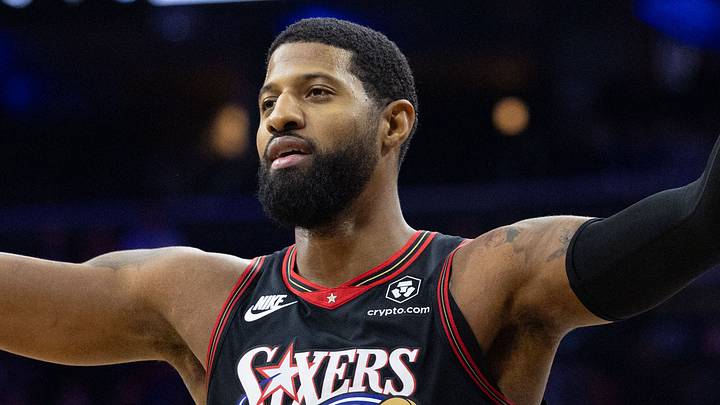
The messaging from the Celtics to justify the wild Jaylen Brown trade, rightfully so, continues to be about Brown’s contract, how untenable it is to have two players accounting for 70% of the salary cap, and optionality going forward. A common counter is to point out that the newly acquired Paul George makes almost as much as Brown over the next two years.
And while that’s technically true (Brown will make $57.7 million, $61.7 million, and $64.6 million over the next three years, while PG makes $54.1 million, then has a player option for $56.6 million), there are a lot of factors that went into this.
Jaylen Brown trade is just step 1 for the Celtics
For one, the process of diversifying JB’s money was always going to be a multi-step process. No team has a $50+ million trade exception to just absorb Brown’s deal. The Celtics essentially had to take back a massive contract to match salaries, and George was the one they liked best.
George makes a few million less each season and expires (at least) a year sooner. That’s just step one in the right direction. Remember how this process played out last season on a smaller scale. The Celtics were saddled with Jrue Holiday’s 4-year, $135 million extension and needed to get rid of it to get below the tax.
The first step was swapping Holiday’s cap hit to Portland for Anfernee Simons, who made $27.7 million. Then, at the trade deadline, Boston flipped that Simons contract for Nikola Vucevic and his $21.5 million. With two moves, they cut over $10 million in salary, and a few months later, Vooch’s contract expired and is now completely off the books.
Of course, the Brown contract is much bigger, and he’s a better and more integral player than Holiday was, but the idea is very similar. Boston has saved a few million in the short term, making it much easier to stay under the luxury tax again. They can also flip PG with some picks to break that contract down again if they want.
The Celtics have more options going forward
Trey Murphy III ($27 million in 2026-27) and Dejounte Murray ($32.8 million) are a common example of a package that may interest the Celtics, for example. There’s also a chance that George fits really well in Boston and they can convince him to decline his player option next summer and re-sign on a longer, cheaper deal.
And then if they want to get back in the mix, Boston could always move George next summer when he’ll be a $50+ million expiring, which would allow them to shop for almost any player(s) in the entire league. Even if this goes down to the wire and George simply plays out the final two years, then expires, that’s a much faster off-ramp.
Keep in Mind, Brown was going to want a two-year, $170+ million extension that would have paid him over $320 million for the next five seasons. I love Jaylen, and I hope he gets every penny. But in the current NBA landscape, that’s simply not a survivable contract for a team’s second-best player if you want to win a title. The Celtics realized this, and that’s why they decided to cut bait and recoup their losses. The PG trade was the first step in reaching the Celtics’ goals, but it certainly won’t be the last one.
 Add us as a preferred source on Google