

Why?
That’s the number one question that Boston Celtics fans have been asking themselves, their loved ones, and anyone who would listen to them over Fourth of July weekend.
The fanbase remains stunned after seeing their longest tenured player, Jaylen Brown, traded away for a subpar return. How could a 36-year-old Paul George, two first-round picks, and two second-round picks replace what Boston had with Brown?
Brown, by the way, who was coming off of the best season of his career.
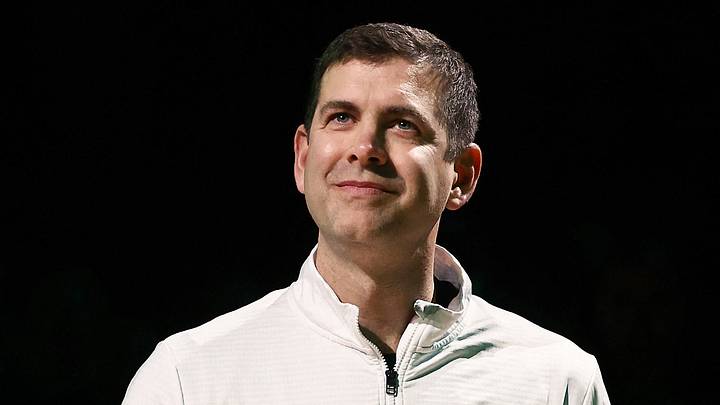
Well, those fans have a bit of an answer now. When Celtics president of basketball operations Brad Stevens addressed the media on Monday afternoon, he wasted no time shedding light on the “what’s in it for us?” part of the deal.
"When I looked at our team, and I looked at where the league was heading, looked at the way that we've finished the last couple years, and also looked at the unbelievable way we played in the regular season in the last couple of years,” Stevens told reporters via CLNS Media. “The path looked a little bit more challenging to me -- I might be wrong, not going to stand up here and be defensive about that -- but the path looked a little bit more challenging with 70% of our cap and such a high percent of our usage tied into two players."
It makes sense. As painful as this entire process was and continues to be for fans of the team, there’s going to be a time where it’ll have made financial decisions easier on them. Brown still has three years remaining on his supermax contract. There’s no doubt that he would’ve been looking to ink an extension, likely for a similar price, before the deal expired.
If there’s one thing that should be clear at this point, it’s that the Celtics weren’t as eager to discuss additional years on the deal. By the time Brown’s next contract begins, he’ll be 33 years old. Assuming that Boston (or the Philadelphia 76ers) was to offer an extension, it likely would’ve paid him supermax money up until he’s at least 36 years old.
With the Celtics already being wary of committing that much money to Brown, as he’ll soon be 30, they definitely wouldn’t have loved to do it when he’s 36.
Stevens and the front office, though clearly disappointed to have parted ways with the 2024 NBA Finals MVP, seem to be satisfied with their return. Stevens spoke highly of the draft capital and “optionality” that comes with George and his shorter contract (one year, plus a player option).
Brad Stevens seems excited about Paul George
The Celtics also seem to think George will help them win games in the short term.
"I'll start off by saying we like Paul,” Stevens praised. “Paul's a really good player. We're not very far removed from all sitting in our series against Philadelphia and watching Paul be a guy that could carry you for portions of four quarters or a half, but also play a complementary role on both ends of the floor at the highest of levels."
George makes roughly the same salary as Brown, though he did reportedly waive his $3.9 million trade kicker to join the Celtics. Acquiring him doesn’t immediately enable the Celtics to creatively pivot and land another star. But, if they feel they’ll have opportunities to take a big swing on a trade or free agent in the next two years, his contract could be a tool in doing so.
He also could compliment the Cs well, as Stevens said. The nine-time All-Star showed Boston how impactful he could be back in the playoffs, when he helped the 76ers overcome a 3-1 deficit. George played great defense on both Brown and Jayson Tatum, while drilling 55% of his triples.
Fans shouldn’t expect that level of efficiency, but there’s some sort of vision for PG in Boston.
 Add us as a preferred source on Google