

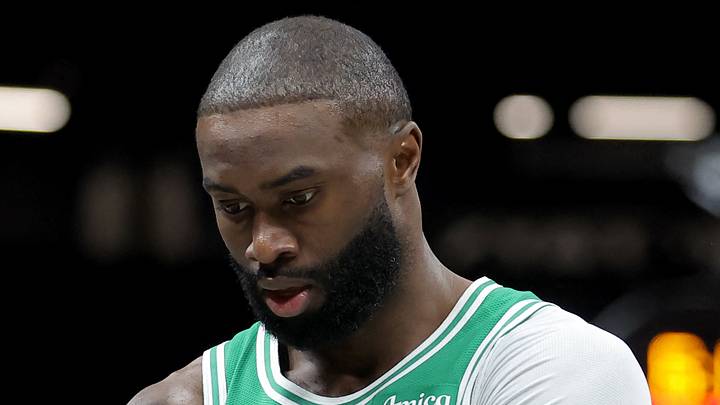
Obviously, at Monday’s press conference, fans heard constantly about optionality and 70% of the cap being tied up in two players. The messaging from Brad Stevens and Bill Chisholm seemed very intentional and specific, but when you actually dig into what they’re referencing, it makes a lot of sense.
The Celtics had reached the point where they had two players, each on their third contracts, making supermax money. As Brad mentioned multiple times, the team had its two best players taking up 70% of the salary cap, and in the modern NBA, and with this current CBA, that’s simply not a recipe for success.
Why the Tatum-Brown supermax duo became untenable for the Celtics
Just look at examples of recent champions in this era. The Knicks had almost 60% of the cap going to two players, but that didn’t include Jalen Brunson, who made less than Karl-Anthony Towns and OG Anunoby. In 2025, when the Thunder won it all, they had Shai Gilgeous-Alexander on a 25% max, and Chet Holmgren and Jalen Williams were still on rookie deals. The only other player making over $17 million was Isaiah Hartenstein.
The Celtics won before Brown or Jayson Tatum’s supermax deals had kicked in, and their two highest-paid players were actually Jrue Holiday and Kristaps Porzingis. And on and on it goes. In fact, the last time that a team dedicated over 60% of the cap to its clear two best players was the Warriors in 2017-18, when Kevin Durant and Steph Curry accounted for 60.23%.
That was a very different era, and frankly, that Golden State squad is a big part of the reason we have this new CBA in the first place. But when you dig into a lot of these teams, it quickly becomes clear why Stevens and the Celtics concluded that moving forward with the Tatum/Brown duo was untenable.
Celtics re-making roster for modern NBA
Boston needs a reset. It’s still far from a finished product. They still have too much tied up in Paul George, the matching salary in the Brown trade, but this was the first move in resetting the deck around Tatum. The goal is clearly to diversify the roster with depth and smaller contracts. They’ve started the process by extending Neemias Queta to a team-friendly deal, and that trend should continue with more of the young depth pieces.
Optionality to keep all of the young talent without hamstringing the roster now exists, and Stevens can add pieces that fit, like the Mitchell Robinson signing. The puzzle is far from completed, and Stevens still has a long way to go in terms of building out the roster in his image in a way that makes sense.
But there’s no doubt about why the Celtics made this move, and the more time passes, and the more we see the corresponding moves, the more this will all likely make sense.
 Add us as a preferred source on Google