

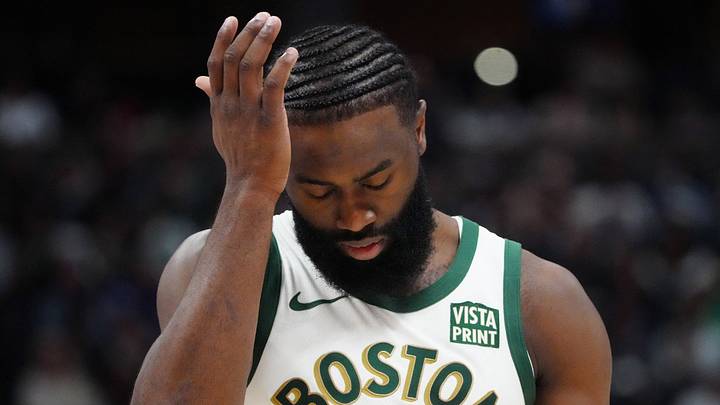
The Philadelphia 76ers acquired Jaylen Brown from the Boston Celtics for the obvious reason: he's a more talented player than Paul George. They are evidently operating with the "talent wins out" approach, as further emphasized by their addition of LeBron James. However, that's not always the case, as one forgotten Celtics trade proves why process can beat talent.
For anyone wondering which trade I'm referring to, it's the one where the Celtics traded Rajon Rondo to the Dallas Mavericks back in 2014. Dallas acquired the ex-Celtics star for the same reason the Sixers got Brown. Long story short, they were dead wrong about what Rondo would bring, leading to a spectacular backfire.
There were questions about how Rondo would fit with Dallas' offensive scheme ahead of time, as he was a ball-dominant, pass-first guard who needed the ball in his hands playing on a team that thrived with its motion offense. In little time, it turned into an outright disaster that has put Rondo in Mavericks infamy, rivaling that of Nico Harrison.
But it wasn't just that Rondo was a bad fit with the Mavericks. They also traded lesser players talent-wise who fit exactly what they wanted to do to Boston, like Jameer Nelson, Brandan Wright, and, most notably, Jae Crowder. None of those three were as good as Rondo was (not even close), but they played an undeniable part in why the Mavericks were a well-oiled machine.
Because they had no choice but to adapt to Rondo, it more or less ruined their season, as they basically mixed oil and water. They took a gamble on the better talent, but sacrificed part of their identity, and it backfired big time. Adding insult to injury was that the Celtics got a lot more out of Crowder than the Mavericks got out of Rondo.
This isn't the same situation, but it's not too far off
Brown isn't Rondo, but he's not simply a player you can just plug into any role and expect him to thrive in it. The 76ers are loaded with talent, but they also may relegate Brown to a considerably lesser role than he had with the Celtics. He may very well adapt to being third or fourth in the pecking order, but his history makes that notion a little iffy.
The Celtics went in the opposite direction from the Sixers now, and the Mavericks 12 years ago. George isn't currently as talented as Brown, but Boston didn't acquire him thinking he would be. They simply believed George fits much better with what the style they like to play.
They also made this deal anticipating that the rest of the roster would make up for Brown's absence. Not just from their current wings besides George, but also from players like Payton Pritchard stepping up in Brown's place (something he did when Boston asked him to).
Dallas sacrificed basketball fit, hoping for a higher ceiling by acquiring Rondo, and oh boy did they come to regret that. Boston sacrificed their second-most talented player, hoping the team is functional enough to make up for it.
Of course, there will be plenty of skepticism about whether the Celtics will be right about this, but Brad Stevens has shown he knows something the rest of the NBA world doesn't. The whole is greater than the sum of its parts, and the Brown trade signifies how much the Celtics subscribe to this belief.
 Add us as a preferred source on Google