

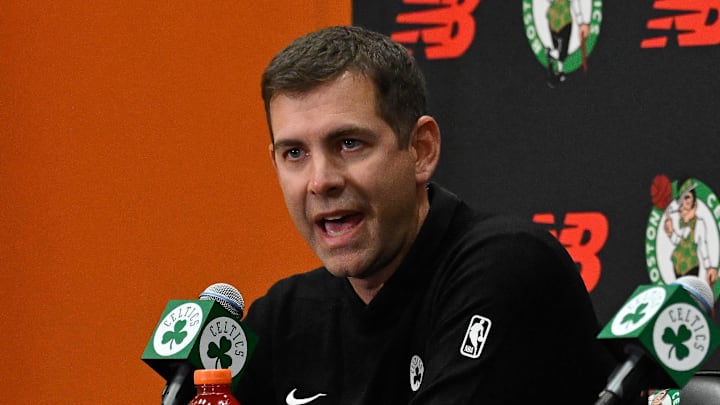
Financial flexibility played a massive role in the deconstruction of the Boston Celtics’ roster this summer. Jrue Holiday, Kristaps Porzingis, Luke Kornet, Al Horford, and Georges Niang all became cap casualties in Boston’s effort to dive below the league’s second-apron threshold.
Combine those money moves with Jayson Tatum’s torn Achilles recovery, and you’ve got yourself a hypothetical “gap year.” Expectations were low heading into the season, with many fans quietly hoping for a tanking team, and some looking at ways for Boston to offload an extra $12 million in salary to get beneath the luxury tax line.
Now, 21 games in, the Cs are three games above .500 with some impressive wins under their belt, including Tuesday’s victory over the rival New York Knicks. The idea of tanking is almost completely dead, and this squad is shaping up to be one of the most fun Celtics teams in recent memory.
(Yes, they won a championship two years ago, but there’s a difference between taking care of business and unexpectedly stumbling into an awesome team like this.)
“It’s only been 20 games, and there has been a huge amount of growth, from a lot of guys,” Jaylen Brown praised after Tuesday’s win. “Neemi[as Queta], Jordan [Walsh], Josh [Minott], Baylor [Scheierman], Payton [Pritchard]. We’re continuing to take it one step at a time. The best is yet to come. We’ve still got a lot of work to do.”
The Celtics are now in a financial pickle
The idea of making a financially-fused trade is becoming more conflicting by the day. On one hand, if the Celtics elect to trade, let’s say Anfernee Simons’ $27 million salary, in order to dive beneath the luxury tax line this season, they’d set themselves up to avoid paying the repeater tax if they stay below the threshold next year, too.
There’s no direct roster-building penalty that comes along with being a repeater-tax team, but the exponentially higher tax rates make it more difficult for ownership to sustainably fund the roster.
If there was ever going to be a season to commit to the financial reset, this was it.
Until it wasn’t.
With how well Boston was played, especially after their 0-3 start, it would feel unjust to rob this group of the opportunity to push for a playoff run. Don’t get it twisted, Simons is by far the easiest player to part with when considering production vs. dollars spent. He’s struggled to fit into his bench role with the Celtics, but there’s a chance that he becomes more comfortable over time. There’s no question that he can help them win games with his sharpshooting ability. If his creativity comes along, then he makes the bench all the more dangerous.
There’s also the part where no team seems to be all that interested in Simons. Like, if the Celtics trade him, there’s a decent chance they’ll have to attach draft capital to move his salary.
Sam Hauser is another player whose name comes up in hypothetical tax-dodging trade talks. Giving up on him and his team-friendly contract just to avoid the tax would be a mistake. He’s played too large a role on the championship-level teams of years past and has grown quite a bit as a defender this season.
Losing either player, especially for nothing more than tax relief, would hurt this team’s chances of competing this season. It would, however, perhaps incentivise ownership to spend big once they’re able to avoid paying the additional repeater tax.
It’s quite the pretzel.
 Add us as a preferred source on Google