

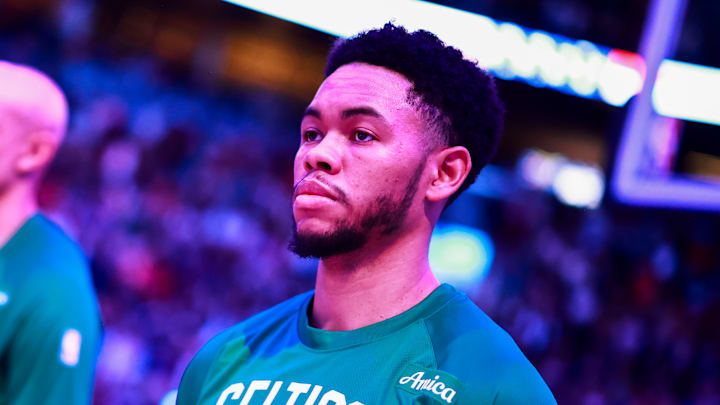
The Utah Jazz are slowly turning themselves into the perfect Anfernee Simons trade partner for the Boston Celtics to work with at the upcoming deadline. They have just enough cap space and tradable pieces to make a three-team deal relatively reasonable, all while the Celtics would be able to duck the tax.
Simons has shown some flashes of solid play, but if Boston decides it would rather get under the tax line this season in an effort to reset the repeater tax in the long run, trading him makes sense. The Jazz have lost five games in a row, rapidly losing any hope of making a run at the Play-In, which could alter their deadline plans.
They’ve begun to look like a prime landing spot for Simons.
Jazz are looking like a prime Anfernee Simons trade destination
Utah has a little bit of cap flexibility to work with this season, which would allow them to take on a little bit of extra money in a potential Simons deal. However, a three-team trade would be the easiest way to help everyone involved.
Perhaps a team like the Phoenix Suns could be interested, if given enough motivation to make a deal, especially with how little Nick Richards has played this season.
Here’s an outline of a potential trade that could aid all parties involved:
Celtics receive: Kyle Anderson, Nick Richards
Jazz receive: Anfernee Simons, Chris Boucher, Two second-round picks (via BOS)
Suns receive: Georges Niang, Second-round pick (via BOS)
This type of trade could benefit all three teams involved in different ways.
First and foremost, the Celtics would shed roughly $15.8 million in this trade. That would get them below the tax line (even with a tiny bit of wiggle room under it).
Plus, they would save some of Simons’ salary to work with in the summer. Kyle Anderson’s contract isn’t guaranteed for the 2026-27 season, but he’ll make nearly $9.7 million.
That would give Boston some nice trade flexibility this summer to add a center or depth piece to help them gun for a championship. His salary, combined with Sam Hauser’s, would get them pretty far, all while remaining under the tax line.
For Utah, this deal is simple: Add two expiring contracts in exchange for two second-round picks. They won’t have to take on any long-term money, and they’d add to their draft cabinet.
The same can be said for Phoenix. Their draft cabinet is very depleted, so swapping Richards out for Niang in exchange for a second-round pick could be an interesting idea. At this point, they should jump at the chance to get any pick they can get, especially since Richards isn’t really a part of the rotation right now.
 Add us as a preferred source on Google