

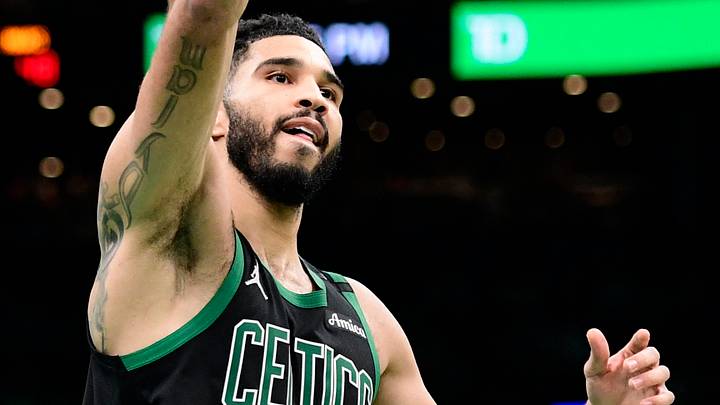
In the opening 24 minutes, Jayson Tatum looks like a superstar. After the intermission, he turns into Clark Kent.
He's averaging 16.3 points in the first half. In the second, that production drops to 10.2. The Boston Celtics' star forward is shooting 34 percent from the field in the final two frames. That includes a 22.6 percent success rate on his 3.6 attempts from beyond the arc. Those account for 42 percent of his shots in the last two quarters. He's also committing 1.6 turnovers per half.
Defenses have held Tatum to under 10 points in the final 24 minutes of nine of Boston's 19 games this season. He has scored 5 points or fewer in seven.
Vs. the Hawks: 4 points, 2-for-11, 0-for-4 on 3s
Vs. the Warriors: 4 points, 0-for-7, 0-for-5 on 3s, 5 assists
Vs. the Nuggets: 4 points, 2-for-6, 5 turnovers
Even in the win over the Washington Wizards, he scored 13 points after the break, but shot 4-for-12, including 0-for-6 from behind the arc.
Explaining Jayson Tatum's second-half swoons
As you would expect, multiple factors are responsible for this. One is how opponents are defending him. A common theme lately has been opponents blitzing him in the second half. They're daring his teammates to beat them. It hasn't happened. As a result, the offense goes dormant.
Derrick White is searching for his shot. Defenses are prioritizing limiting Payton Pritchard's impact inside the arc. He's also shooting 33.6 percent from three-point range. It falls on more than two people, but this highlights how it's going while Tatum's scoring gets muted. The Celtics need people to capitalize on the quality looks his gravity is creating.
And when the six-time All-Star can rise and fire, his shot quality and effective field goal percentage, which adjusts for a 3-point attempt being worth more than a shot inside the arc, both plummet in the second half.
Sometimes, Boston isn't getting rewarded for a sound process. Plenty of well-run possessions haven't ended with a make, no matter who's shooting. Turnovers have been a killer as well. The Celtics had 26 in their loss to the Hawks. That's the most in a matchup in the Joe Mazzulla era.
How can the Celtics fix Jayson Tatum's second-half struggles?
The regular season comes with ebbs and flows. This is an extended rough patch that likely won't last. It's also worth noting that he's played in only 39 games since tearing his Achilles, with the offseason dividing the first 22 and the last 17. However, to expedite solving this, Boston may need to tweak his rotations.
The coaching staff did so in the second half against the Wizards. They subbed him out late in the third frame and brought him in at the start of the fourth. Sometimes, the stretch at the end of the third quarter is more important than the one at the start of the fourth. However, he's averaging 6.3 minutes in the final period. At times, he hasn't been on the floor enough at that juncture, as the margin for error shrinks.
Playing Tatum the entire first quarter also seems to be having a negative effect as the game progresses. It's not as if he's huffing and puffing or hunched over in the second half. However, fresher legs would help boost his productivity.
Tweaking his rotations could help with another issue. At times, he isn't playing with enough pace. It's a team-wide issue the Celtics star is also guilty of. It's spotlighted when he runs the floor to seal a mismatch down low. That's a way to get him easy points and potentially trips to the free-throw line. Both can help him find his rhythm.
What can the Celtics do beyond adjusting Jayson Tatum's rotations?
Boston's trying to leverage him off the ball, which makes him more difficult to contain. However, that method hasn't been as impactful lately. Solving that to get him higher-quality looks and more points at the rim would make a massive difference.
Between that, altering the former Duke Blue Devil's rotations, him playing with more pace, and positive regression, he'll start playing up to his standard in both halves.
Getting the star-powered version of Tatum after intermission would go a long way toward elevating a Celtics offense in need. Their defense is still yielding the fewest points per game. Finding their equilibrium will swing outcomes in their favor and change how this team is viewed.
 Add us as a preferred source on Google