

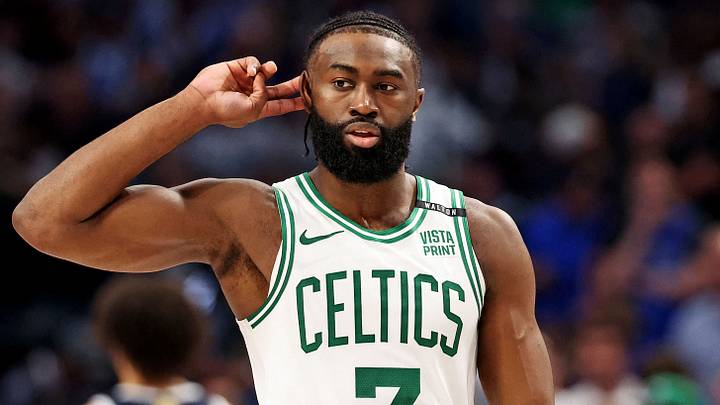
Even those who agree with the Boston Celtics' decision to trade Jaylen Brown understand why it got as much backlash as it did. He was coming off his peak season that factored into the team wildly surpassing low expectations. What many question is why did Boston trade Brown when they had plenty of time to sort out what to do with him?
Bleacher Report's Dan Favale harped on this when naming Boston among the NBA teams that "blew it" this summer.
"They didn't want to extend him? Cool. Brown has three guaranteed years left on his deal. He had no leverage to force the Celtics to offer a new contract or make a trade," Favale wrote.
It's not that this is wrong. It's quite valid to suggest that they had three years to decide what they wanted to do with Brown, but the problem was that once Brown became extension-eligible earlier this summer, and Boston didn't want to give him that super-mega extension where he would have been paid $70 million annually, that would have become an elephant in the room too big to ignore.
Celtics would have risked a lot if they kept him
While there was never any intel confirming this, it's pretty easy to deduce that Brown wanted that extension and the Celtics weren't going to give it to him. Not because of anything to do with him as a player, but because of how much a contract like that would have hurt their flexibility, which wouldn't have looked good after Boston didn't even come close to their previous success over the past two years.
But not giving it to him likely would have fueled some understandable contempt from Brown's side (his previous comments after the season ended and before the trade likely rubbed a few the wrong way). Hence, the Celtics tried to get ahead of it as quickly as possible.
More than that, the league is smart enough to recognize when situations like these happen. Once it was clear the Celtics weren't going to extend Brown, they understood what that meant: Brown was going to hit the market. Maybe the Celtics undersold (although the Clippers' punishment for the Kawhi scandal makes that deal look smarter), but if this had dragged on for years, they may have gotten even less if they had hesitated to pull the trigger.
Remember that this was only one of the reasons Boston traded Brown when they did, as there were definitely more. He was an okay, not great, fit for Mazzulla Ball, Boston kept blowing series they should have won, and keeping Brown limited their long-term options.
Does this change the fact that trading Brown was among the most heartbreaking decisions in Celtics history? No. Could trading Brown to Philly lead to them winning a title? It's definitely possible. But asking why Boston traded him when there were three years left on his deal isn't as rhetorical a question as many would think.
 Add us as a preferred source on Google