

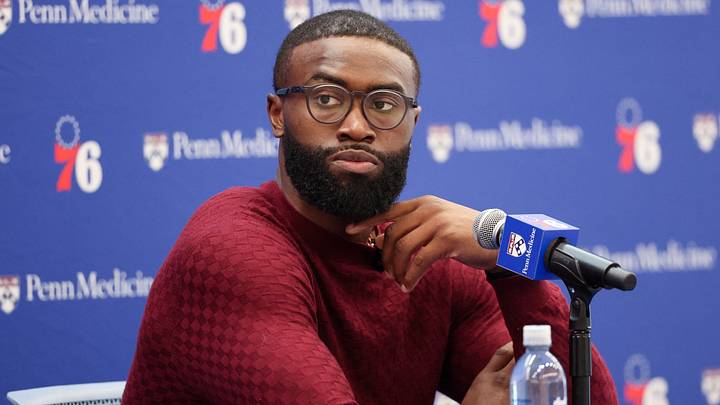
Alright, so we're going on almost three months since the Boston Celtics traded Jaylen Brown. Understandably, the trade has had a divisive reaction because of Boston's success with Brown in the decade he played for the team. The sad part is that there is a legitimate defense to this trade on Boston's end, but it is difficult to defend it without tearing down Brown as a player.
But what if it doesn't have to be that way? Sometimes in a divorce, it's not that the failed marriage featured one or both spouses being bad people. Sometimes, they are good people who just aren't compatible anymore because things change.
That is how it went down between the Celtics and Brown. He is a Celtics legend who definitely left his imprint on the franchise and is coming off his best season as a pro. When it's all said and done, Brown proved Boston was right to pick him in 2016 when many thought they had reached, and the Celtics should not nor do they have any regrets about taking him when they had the chance.
But for all his abilities, the franchise simply did not think keeping him was the best decision. That's not just because he was likely command money they didn't want to give him three years from now, but because he wasn't a spectacular fit for what Joe Mazzulla wants from his players - space the floor, get offensive rebounds, take care of the ball - this was as good a time as ever to part ways.
It doesn't invalidate Brown's talent or his legacy at all. He gave Boston the best he could for them when they asked him to step up. A divorce was simply what the Celtics thought was the best option.
Both sides could get what they want from this
While Brown probably won't get the money he would have asked for from the Celtics, this could be his chance to prove that he never needed Jayson Tatum to play at his best as a Sixer. Even better is that it gives Brown the chip on his shoulder to prove Boston was wrong to give up on him.
There is the possibility he may be a Trojan Horse for Philadelphia (unintentional or no), but Brown at least gets the chance to truly establish his own legacy if he succeeds as a Sixer.
For Boston, among the reasons why they made this deal was they believed Brown was not the best fit for what they want to do, even if it meant trading for a lesser talent like Paul George. In all fairness, they went 9-2 without Brown last season, showing that there is reason to believe that they were onto something.
Narratively speaking, no one wanted it to end like this, but sometimes, for both sides to get what they truly want, they have to understand that they were better off without one another.
 Add us as a preferred source on Google