

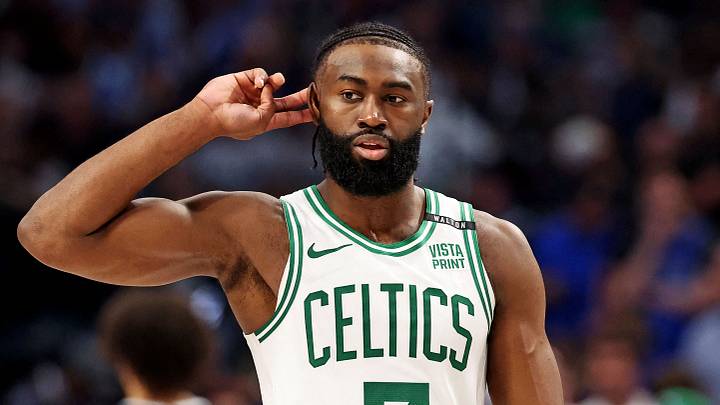
Ever since the Boston Celtics traded Jaylen Brown, he has been the poster boy of the traditional stats vs. advanced analytics argument. It's a real shame it's had to come to this because it's overshadowed the legacy Brown left in Boston, but that's what happens when a team trades an iconic player for what many believed was a massive undersell.
We won't know what Boston will look like without Brown until the 2026-27 season officially starts. What we can do is make educated guesses on where things go from here. What we know is that the Brown trade signals the Celtics' confidence in Mazzulla Ball, among other things. Whether they'll be right about that is technically up in the air.
We also know that Brown put up some pretty nice numbers, and no one's trying to take away from the individual accomplishments he had last season, but here's another fact (per StatMuse): the Celtics were 9-2 in the 11 games they played without Brown last season. Impressive as that is, here are some other factors to consider about the sample size.
-Four of those games were against 10 of the NBA's worst teams record-wise (Washington, Indiana, Sacramento, and Milwaukee)
-They lost that game against Indiana, proving they weren't perfect without Brown by any means
-The other seven were against playoff teams (Toronto, Houston, Phoenix, Atlanta, Charlotte, New York, Orlando)
-Five of those games featured Jayson Tatum
But even so, how did the Celtics compensate without Brown? Because their depth rose to the occasion. Sure, more often than not, Derrick White and Payton Pritchard did their thing, which would have surprised no one, but in games Boston won without Brown, they got major contributions from players you wouldn't have thought beforehand were capable of doing.
The sample size isn't gargantuan, but it is promising enough that Boston may have felt comfortable seeing what they have with the players they believe can replace Brown in the aggregate. They're not as talented as Brown is, but still might be able to replace his impact. If not, more so.
Wait, but that's 11 games. Didn't you say 12 in the title? I did, and the only reason it's not mentioned is that Brown technically played in another game, though he only played in half of one.
Remember that game Brown got ejected?
In their second matchup against San Antonio, Brown got his second career ejection on what was a highly questionable call by the referees just before half, as many will likely recall. What many forget is that despite that, the Celtics gave the eventual Western Conference champions all they could handle. Much of that was because guys like Harper stepped up in Brown's place.
Would the game have had a different outcome if Brown had played? It's definitely possible, but trades like these are a good reminder that the Celtics held steady in what should have been even more adversity.
Also, Payton Pritchard (someone whose numbers were much better in games Brown sat out) didn't play. Even then, the Celtics took one of the NBA's best teams to the wire without Brown. This continued in their other loss with Brown against the Knicks, where, again, the Celtics fought them tooth and nail to the final buzzer.
Who stepped up with Brown out?
The Brown trade will put this all to the test, but Boston's record without him and the film itself shows that this trade might not be so bad for the Celtics at the end of the day.
 Add us as a preferred source on Google