

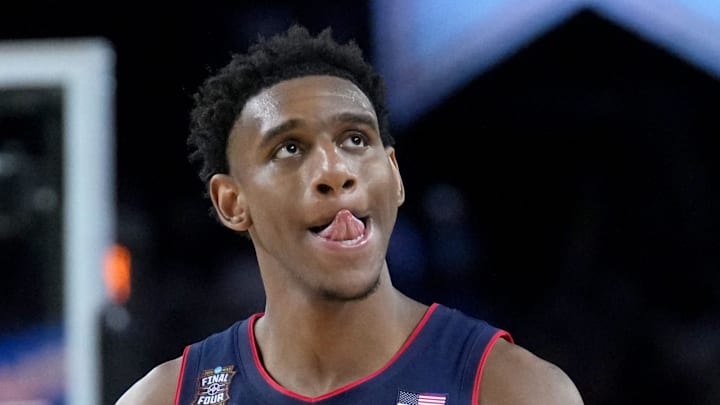
Shopping locally could be an interesting avenue for the Boston Celtics to take in their NBA Draft approach next month. University of Connecticut center Tarris Reed Jr. projects to be available when Boston’s 27th overall pick rolls around, and they may be wise to take him there.
The six-foot-ten-inch, 265-pound big man was named to the All Big East team after a strong senior season at UConn.
Reed appeared in 35 games for the Huskies, starting each time. He averaged 14.7 points, 9.0 rebounds, and 2.0 blocks per game while shooting 60.7% from the field.
What does Tarris Reed Jr. offer to the Celtics?
In short, he’d provide reliable frontcourt depth to a team that could really use it. Boston’s center rotation projects to be thin next season, assuming that Nikola Vucevic has played his final game for the franchise.
Adding a two-way big man like Reed would give them another body there, at the very least.
Offensively, he’d join the Celtics as a rookie with experience as a low-usage scoring option. Reed saw some post-up opportunities at UConn, but made a habit out of finishing around the basket.
He shot 68.2% at the rim, and converted on 63.5% of his layup attempts -- strong numbers that bode well for him as a potential catch-and-finish guy in Boston’s offensive scheme.
Reed doesn’t provide much beyond the paint in terms of scoring. His 61.7% clip from the free-throw line doesn’t add much hope for his potential development as a shooter, either.
The 22-year-old impressed on the offensive glass, as well. Over a third of his rebounds came on that side of the floor at 3.2 per game. His offensive rebounding percentage was great throughout his four-year collegiate career, and sat at 14.2% this past season.
Reed’s nose for extra possessions fits well with what the Celtics thrived in this past season. Boston ranked fifth in the NBA with 16.2 second-chance points per game. Oftentimes, they’d create some of their cleanest looks off of offensive rebound kickouts. There’s no guarantee that the Cs will lean as heavily into that identity next season, but if they do Reed should help them continue to be great.
The Chaminade product also thrives as a screen setter.
“He’s a bruising screen setter who is just as comfortable flattening guards on well-set picks as he is setting a subtler screen where he immediately dives toward the rim,” wrote No Ceilings draft expert Rowan Kent.
Though unglamorous, setting effective screens is an important job for NBA big men. Think about how Luke Kornet has found a role in the league by freeing up his teammates that way. When Luka Garza joined the Celtics last year, he hoped to thrive in that area himself.
It doesn’t stop there, either.
Reed’s 7’4” wingspan enables him to be a defensive menace in the paint. He showed a tremendous ability to protect the rim without fouling as a senior, logging just 2.9 fouls per game to go along with a pair of blocks.
Even when he wasn’t swatting away shots, opponents only converted 31.7% of their attempts at the rim with Reed standing in their way.
At 265 pounds, he’s got the strength to stand his ground and force opposing players into tough shots out of the low post.
Reed still has to grow as a perimeter defender, though. He showed signs of being able to hang with quicker guards, but not enough to make draft experts feel confident that he’d carry that skill with him into the NBA.
For perspective, UConn utilized Reed in drop coverage at most times this season.
The UConn standout showcased impressive, fundamentally sound rebounding prowess throughout the season. He logged a 24.5% defensive rebounding percentage. Reed’s strength and willingness to box out went a long way for him in that regard.
His consistent dedication to improving his game across the board throughout college is yet another green flag.
Reed’s many NBA-level skills should encourage the Cs to take a chance on him if he’s still on the board by the time they make their first-round selection.
 Add us as a preferred source on Google