

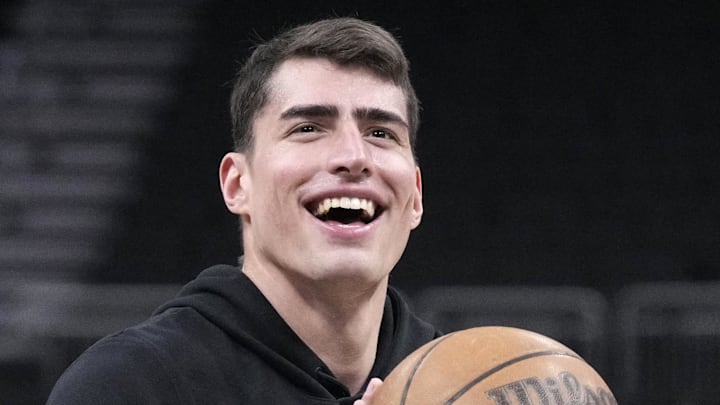
The Luka Garza experience for the Boston Celtics has had its ups and downs. Before the Nikola Vucevic trade, it was all positive for Garza. He had finally figured himself out in Boston's rotation, proving himself to be a keeper, but once they acquired Vucevic, he was relegated to garbage-time minutes, only featured prominently if Boston was undermanned.
With Vucevic out for a month or so, Garza's been re-inserted into the rotation, and the Celtics haven't skipped a beat. It's only been two games, but he has done what Boston has asked. If the winning ways continue until Vucevic's return, it could start a controversy as to which center the Celtics should roll with in the postseason
Vucevic's name recognition is precisely why Garza was benched in the first place. Yes, it was unfair, but everyone understood why. It wasn't like Vucevic was a game-changer (it's not like Boston needed one since they knew Tatum was coming back), but his gravity made him a more recognizable threat than Garza.
Even so, just because a player is more talented doesn't mean he's a better fit. Garza needed a minute to figure himself out, but Boston has gotten the best production of his NBA career.
If that only continues in Vucevic's absence, when he comes back, Boston could have a problem deciding who should get the nod as the backup big, especially with the playoffs right around the corner.
The little engine that could, who proved how he can help in his own way, or the former All-Star whose had some understandable growing pains but has proven how lethal he can be when he's got it going.
The biggest upside is that they have both of them
Boston didn't just acquire Vucevic because he helped them save money and was an upgrade over Garza on paper. They did it to get themselves some frontcourt insurance. As good as Garza and Neemias Queta have played, that was the roster's only two playable and dependable bigs. It could have been disastrous if one of them had gone down, so getting another made sense.
Vucevic has some red flags that have already shown themselves, so if, say, he gets the nod and those red flags stand out like a sore thumb, that's where someone like Garza would make sense to sub in when that happens.
That's the beauty of this frontcourt depth that many were concerned about well before Garza even asserted himself or the Vucevic trade. Perhaps the better way to look at this is the glass-half-full view: having three bigs who can play in marquee matchups is a great benefit.
Boston may not boast the same frontcourt they once had back when they had Kristaps Porzingis, Al Horford, and Luke Kornet, but their frontcourt is strong enough that they don't have to worry about it being exploited in the postseason until further notice.
 Add us as a preferred source on Google