

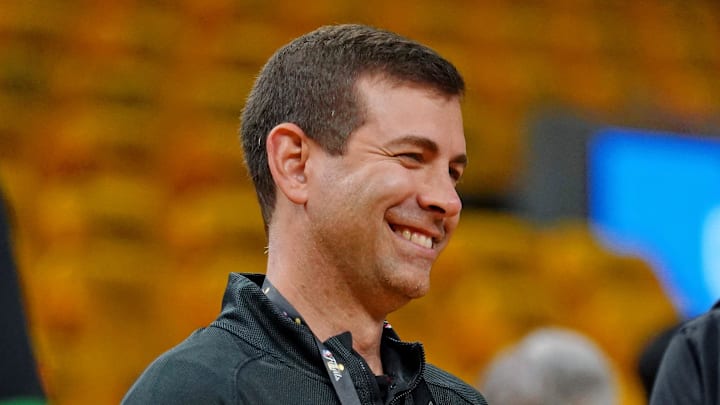
For the second time in three seasons, Boston Celtics president of basketball operations Brad Stevens has won the NBA’s Executive of the Year Award, the league announced on Tuesday.
Of course https://t.co/FUHmMWfAuJ pic.twitter.com/aTY0KcWh4w
— Sam LaFrance (@SamLaFranceNBA) April 28, 2026
Stevens placed first in the polls by a landslide, outscoring the next-highest vote-getter, Atlanta Hawks GM Orsi Saleh, by 28 points.
The voting panel for the 2025-26 NBA Basketball Executive of the Year Award consisted of basketball executives from NBA teams.
— NBA Communications (@NBAPR) April 28, 2026
Complete voting results ⬇️ pic.twitter.com/uPIrI0Uzvn
He is also the first Celtics general manager to ever win the award twice.
The honor should come as no surprise, really. Stevens and the rest of Boston’s front office navigated significant change with grace last summer. Key rotation players like Jrue Holiday, Al Horford, Luke Kornet, and Kristaps Porzingis all left for new homes, one way or another, while Jayson Tatum was expected to miss significant time recovering from a torn Achilles tendon.
Brad Stevens and the Celtics turned disaster into dominance
When faced with said adversity, they absolutely cooked.
The Celtics shed $41 million in salary when they traded away Holiday and Porzingis last June. Not only did they manage to save money and avoid a third-straight season as a second-apron team, but they set themselves up for success, too.
Anfernee Simons, though he only played a half season in Boston, was a fine addition in return for Holiday. Of course, the Cs rerouted him to the Chicago Bulls at the trade deadline in exchange for Nikola Vucevic. Vucevic hasn’t always fit cleanly into what the Celtics are doing, but he’s been an undeniable help through four playoff games.
A key component of successful team-building in the NBA with multiple super-max contract players on the roster is hitting on the margins (the same as Joe Mazzulla would tell you is key in-game, too).
Stevens’ ability to round out Boston’s roster with strong low-budget additions went a long way in their 56-win campaign. New faces like Luka Garza, Hugo Gonzalez, and Josh Minott each helped them win games for stints, while returning fringe players like Baylor Scheierman, Jordan Walsh, and Neemias Queta did the same.
Believing in said group of guys goes a long way. Instead of panicking and making desperation moves, the Cs trusted those already in-house, as well as their player development staff.
Even with low external expections dominating preseason headlines, Stevens refused to put a ceiling on this group.
Stevens’ brilliance stems far beyond just this season, too. Decisions like extending both Payton Pritchard and Sam Hauser on team-friendly contracts have enabled the Celtics to lean on continuity. Pritchard’s $7.7 million salary has to be the best non-rookie contract in the league.
Both men are examples of how Boston’s desire to utilize every roster spot -- something they’re still leaning into -- pays dividends. Each spent multiple seasons mostly glued to the bench before earning a full-time rotation spot.
This season, the same sort of thing can be seen with Ron Harper Jr., who was converted from an Exhibit-10 contract, to a two-way, and eventually earned a multi-year deal earlier this month.
No detail goes overlooked in Stevens’ front office.
 Add us as a preferred source on Google