

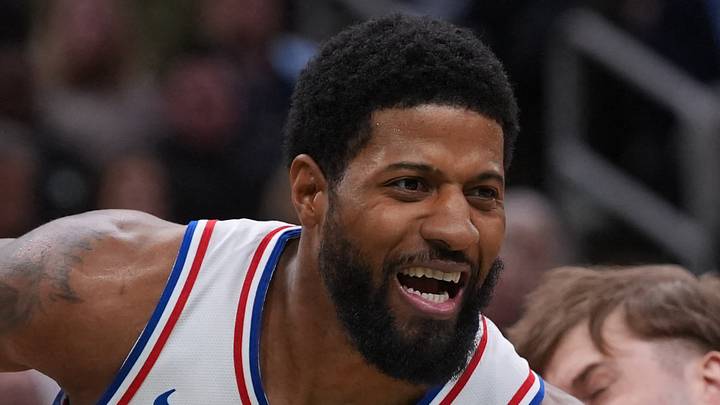
There’s plenty of reason to believe that the Celtics plan to use Paul George’s expiring contract in a major trade to upgrade the roster next summer. PG will likely pick up his player option and enter the last year of his deal, set to make $56.6 million for the 2027-28 season. Boston will likely have reset the repeater tax by staying under the luxury tax this season, and they’ll be ready to spend big again.
They can use George’s contract along with draft picks to go hunting for the star of their choice to be Jayson Tatum’s new co-star for the next era. It’s a very logical plan, and especially if things don’t go great with George this season, it’s probably the team’s best path to acquiring another star-level player any time soon.
In the Jaylen Brown/Paul George swap, the Celtics acquired two very valuable first-round picks and two seconds that they can package with their own and put together a very appealing trade package to dangle around the league and see what they can get back. But it’s not quite that simple.
Trading George for player making more $ will impose first apron hard cap
One important thing to remember about the new CBA is that any team without cap space that takes in more than 100% of the money they send out in a trade will be hard-capped at the first apron. Given the trouble that the Celtics are going to in order to reset the tax penalties and create optionality, it’s hard to imagine they’ll hardcap themselves again next season.
They will surely want the ability to spend over the first apron, and maybe even the second apron, but if they trade George for a player making more than him, that won’t be an option.
Luckily, that shouldn’t be a huge problem as there are currently only 10 players slated to make more than PG’s $56.6 million next season. But still, that list includes some potential targets like Devin Booker, Donovan Mitchell, Anthony Davis, or possibly even Nikola Jokic. There are also players who could sign new deals next summer for more than that amount (one Steph Curry comes to mind).
In that instance, the Celtics would need to add money to make the deal work and keep their optionality to spend freely. Which, again, isn’t a huge deal, but it’s something to keep in mind as they’d likely have to add at least one good, young player in to make these hypothetical trades work.
Celtics should look for cheaper 'star' or multiple players
But even then, unless it’s someone like Jokic, do the Celtics really want to sell the farm just to take on another supermax player taking up 35% of the cap like Brown and Tatum? They’d be better served to try and trade George for two or three good players on cheaper deals or a younger star making 25-30% of the cap.
It’s hard to imagine who could be available a year from now and what the landscape of the league might look like, but some guys who fit the mold could include Franz Wagner, Lauri Markkanen, or Zion Williamson. Maybe they could revisit the Trey Murphy chase, or look at someone like Jalen Johnson or Chet Holmgren. This is all just hypothetical, and in reality, Brad Stevens and company are probably scheming up something that’s not even on anyone’s radar.
The point is, they’ve got all the options in the world, but there is still some red tape to work around, and a big part of that is avoiding any moves that would hard cap them beyond the coming season. It shouldn’t be a problem, and I trust them to take care of it, but it’s something important to keep in mind when dreaming up deals for next offseason.
 Add us as a preferred source on Google