

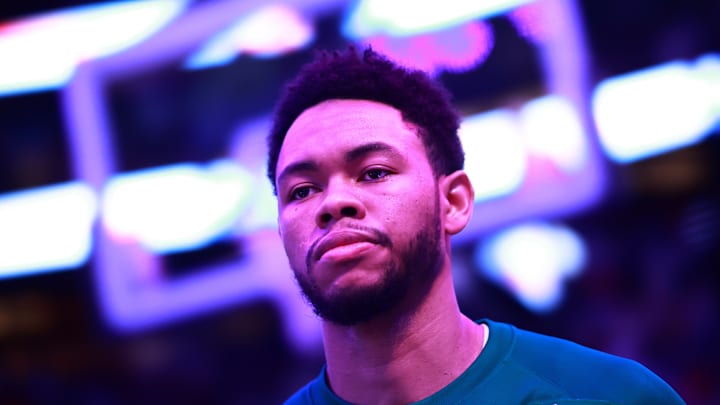
The Boston Celtics entered the offseason with the goal of severely slashing payroll to get under the tax aprons and reset the clock, setting them up to return to contention when Jayson Tatum was healthy. They are now realizing they should have gone all the way, as players like Anfernee Simons and Sam Hauser lose value by the day.
The combination of trades that the Celtics made this summer were highly successful from a financial standpoint. They moved off of the aging Jrue Holiday and his lucrative contract for free, bringing back Anfernee Simons and sending out zero draft picks.
Boston also sent Kristaps Porzingis to the Atlanta Hawks and took back very little money. Those two moves dropped them down below the tax aprons and were excellent value in a vacuum.
The problem is that the Celtics didn't complete the mission. They remain $12 million over the luxury tax line, a reality that is not merely a little money from their new owners' pockets. The Celtics have been in the tax long enough to be accruing repeater tax penalties, and getting out of the tax this season would provide a huge step toward resetting that repeater clock, which could mean hundreds of millions of dollars in savings over the next half-decade.
The thought was that the Celtics could showcase Anfernee Simons and Sam Hauser across the start of the season and then move one or both in a trade deadline deal that would shed that final $12 million in the process. They made the hardest moves over the summer; it would just take a more modest deal to finish the process.
One problem: Simsons and Hauser have not been good to start the season.
The Celtics' players are tanking their own value
Simons developed into an explosive scorer in Portland, averaging as much as 22.6 points per game in 2023-24. He is a knockdown shooter who can launch off the catch and off the dribble, has crafty finishing and became a reasonable secondary playmaker. He is the quintessential modern shooting guard.
Unfortunately for Boston and for Simons, that model is not terribly in vogue in the NBA right now. A guard-sized shooting guard who struggles on defense -- Simons is 6'3" and has always been a defensive train wreck -- is exactly what most teams are trying to get away from. They want size and defense on the wing, not ball-dominant scoring and turnstile defense.
Simons could convince some team on the back of elite production, but it hasn't come in Boston. He is averaging only 13.1 points per game on 43.4 shooting from the field, a much smaller role than he is used to. Many players can scale into a smaller role by becoming more active and more efficient; Simons has done none of that.
The Celtics' other main option for a trade would be Sam Hauser, who has been a key player on their team over the last few seasons as a knockdown shooter but is not a core member. He may be sticking around, however, and not because he has proven himself indispensable, but because no one wants to take a shot on a shooter who can't shoot.
That's not to say Hauser has been ice-cold, but he has certainly been cooler than expected. After four-straight seasons of shooting at least 41.6 percent from deep, Hauser is at a more league-average number of 36 percent. Even more worrying is the fact that his 2-point shooting has tanked; he is taking less than one shot per game inside the arc, and making just 34.8 percent of them.
Hauser's turnovers are up, his defensive impact is down, and he is just starting a new contract. Already 28 years old, there is likely real concern from trade suitors that Hauser's production was a product of the Celtics' system, and that outside of the perfect ecosystem, he will struggle. It's what appears to be happening this year on a diminished version of the Celtics.
The Celtics will try to move one or both players by the deadline and get under the luxury tax line, but their job has been made much more difficult by the poor play of Simons and Hauser. It is becoming increasingly clear that the Celtics should have finished the job and made it under the luxury tax this summer when both players had strong value.
By waiting until now, the Celtics will find it very hard to complete the mission. They pushed off the final step, and now it may prove to be outside of their grasp -- or much more painful to accomplish.
 Add us as a preferred source on Google