

The 2026 NBA Draft is getting closer by the day. Next month’s two-night event will see the Boston Celtics (most likely, barring any trades) add two new young players to their roster with picks No. 27 and 40.
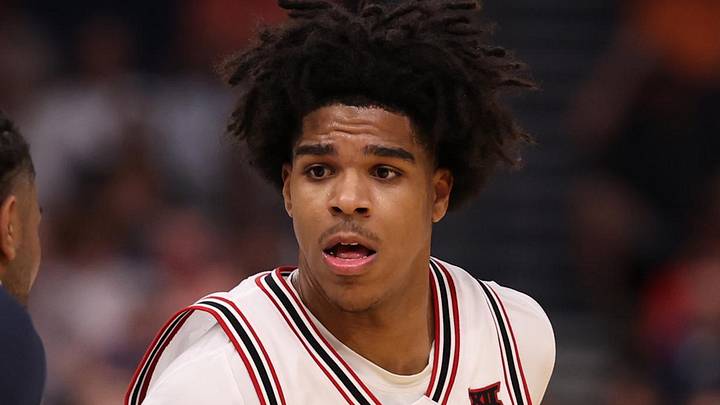
Texas Tech guard Christian Anderson is an intriguing prospect who is projected to be available in or around Boston’s range.
The six-foot-one-inch, 180-pound point guard was named to the All Big 12 team and won the conference’s Most Improved Player award after his strong sophomore season.
Anderson appeared in all 33 games this season for the Red Raiders. He averaged 18.5 points, 7.4 assists, 3.6 rebounds, and 1.5 assists per game while shooting 45.5% from the field and 41.5% from beyond the arc.
What would Christian Anderson bring to the Celtics?
Anderson’s game could enable him to be a great microwave guard off of Boston’s bench, with upside as a true ballhandler.
His shooting ability stands out more than anything when watching tape from this past season. The 20-year-old showcased a strong ability to create space for himself on the perimeter as well as the knack for drilling tough self-created threes.
Anderson thrived as the ballhandler in the pick-and-roll, as well. He did a great job of reading what defenses gave him in those situations all year, which explains his high assist average. Whatever the situation is, Anderson has the right pass for it with either hand. It doesn’t matter.
The aforementioned off-dribble shooting ability plays a role in his success here, too. The Atlanta native is a threat to score on all three levels.
He can knock down threes from anywhere, pull up in the midrange, and finish well at the rim.
When thinking about how a player like Anderson fits within a pro rotation, especially a competitive one like Boston’s, it’s important to consider how frequently he’ll be able to utilize the skills he showed in college. Something like shot creation is hit or miss.
In some regards, he’ll have less of those opportunities, as he was very much a “do it all” guy for Texas Tech. At the same time, having that ability will come in handy if he finds himself in small one-on-one situations off the catch. Imagine the way that Payton Pritchard can create something out of nothing when he gets a pass in the corner later in the shot clock -- that sort of thing.
It’s probably a bit ambitious to believe Anderson would be an immediate-impact guy in the NBA. But, whenever he does reach his potential, he could be the sort of player that adds an extra layer to the Celtics’ three-point-dependent offense because of how well he navigates the pick-and-roll.
Now, the reason why it’s ambitious to have immediate high hopes is because of Anderson’s size. At just 6’1” and 180 pounds, he’s the exact type of player that opposing teams can be physical with on both sides of the floor.
He averaged 3.3 turnovers per game this season. NBA-level physicality could be tough for Anderson to deal with cause him to cough the ball up more often than he’d like.
He’s going to have to put on muscle to avoid that as well as becoming a defensive liability. That’s not to say that Anderson doesn’t give his best on defense, though. Unfortunately, in the NBA the physical tools are extremely important.
That’s not to say there isn’t time for Anderson to develop his body. From his freshman to sophomore season, it’s easy to see the improvement he made to his game as a whole. No player is a finished product on draft day (at least you’d sure hope not). Work ethic and commitment to improvement are just as important as some of the numbers that show up in the statsheet.
So is durability. Anderson got in his Tony Stark bag this past season. He averaged 38.4 minutes per game (reminder: in college games are only 40 minutes). The fact that he managed to keep himself on the court and bring elite effort at all times speaks volumes. Playing that many minutes isn’t simply an homage to endurance, either.
You have to play smart and avoid committing careless fouls -- of which Anderson averaged just two per game.
Anderson has the making of a high-ceiling prospect. If he develops his body to be able to handle pro physicality, clean up his turnovers, and prove he can defend at an NBA level, then there’s reason to believe he can contribute to winning at a high level.
The if there emphasizes that the range is pretty wide for him. Anderson could find himself glued to the bench or racking up minutes in the G-League if he isn’t able to improve his weak points.
Considering how low the Celtics are picking, there’s going to be some level of that with every prospect.
 Add us as a preferred source on Google