

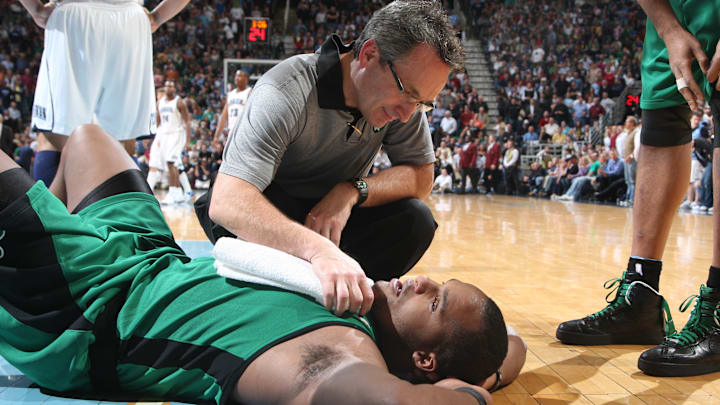
In the blink of an eye, Dr. Ed Lacerte and his family saw their world change. His symptoms and diagnosis of acute monocytic leukemia occurred suddenly and out of nowhere, according to them.
How are they responding to the fight for his life? By trying to save as many people as possible.
Thanks to Lacerte's family, the Boston Celtics, the NBA, USA Basketball, and the National Basketball Athletic Trainers Association [NBATA] have partnered with the National Marrow Donor Program [NMDP] to raise awareness for its registry.
Lacerte spent over 30 years as the head athletic trainer and physical therapist for the Celtics. He is the longest-tenured athletic trainer in their history.
He was also the athletic trainer for the gold-medal winning "Dream Team" in 1992. Lacerte served as the Treasurer of the NBATA from 1988 to 2018. He earned the Joe O'Toole NBA Athletic Trainer of the Year Award in 1993, 2012, and 2015.
The decision to share such a private matter with the world wasn't easy. However, the Lacerte family opened up about their father's diagnosis, recognizing the profound impact they could have by doing so. It's a courageous act that is driving awareness to the NMDP and its registry on a global scale.
"It's obviously been incredibly hard to talk about, but we know that by sharing his story, we can help raise awareness for NMDP – not just to find our Dad a match, but to help thousands of others searching for their match too," shared the Lacerte family.
"When we told our Dad that we were working on this with the NBATA, [the] Celtics, [the] NBA, USA Basketball, and [the] NMDP, he immediately expressed his support to share his story, knowing how many people it could potentially help. He's spent his whole career helping others, so it was no surprise to us that he'd have the same desire to continue helping others however he could even during his own fight."
Inside the NBA and the NMDP's partnership
From the Celtics to other franchises around the Association and the league's headquarters, the NBA is playing an active role in trying to find Lacerte a match as he prepares for a blood stem cell transplant once in remission.
Marcus Smart has joined the fight as well. When his career began in Boston, Lacerte was the Celtics' head athletic trainer. Tragically, this is a fight the former is all too familiar with. Smart lost his mother to blood cancer. He has partnered with the NMDP, using his platform to help raise awareness for the registry.
Speaking about the league's efforts and about the urgent need for young, diverse blood stem cell donors, Annie Horn, the NBA's director, social impact and inclusion and sustainability, shared, "We're teaming up with [the] NMDP to try and raise awareness about the need for blood stem cell donors, about the need for a blood stem cell match for Ed Lacerte, and also to inspire fans who are 18 to 35 towards action in signing up to be on the blood stem cell donor registry.
"There's such an urgent need right now, and Ed Lacerte, a beloved member of the NBA family, the Celtics family, USA basketball, he's cared for generations of players, and now it's -- now the community has a chance to support him."
They're doing so through efforts like the Celtics hosting three registry drives during home matchups at TD Garden this season. They air videos during games to help raise awareness, and they held a drive at practice.
Those initiatives are proving incredibly successful.
"People have to see a message a number of times, right, before sometimes they take action," said Horn. "And so those repeated reminders definitely help. Getting more members of the Celtics family involved helps. We saw [Indiana Pacers head coach and former Celtic] Rick Carlisle at his media interview several days ago, speak about it. Other members of the NBA and [the] Boston Celtics family, continuing to raise awareness, every time, it helps.
"The Celtics stepped up immediately to support Ed and his family. And I think that speaks to the type of organization that they are and their values, through hosting games, through awareness on social media and digital and broadcast, through the drives at practice, even at their office too. So, they've done an incredible job, and other teams are stepping up now as well. We're looking to host registry drives at our NBA headquarters office as well. So lots more to come."
In just over a week, these efforts led to nearly 700 people joining the registry. What the NMDP is looking for are diverse donors between the ages of 18 and 35.
To reach that audience, they've found an ideal partner in the NBA.
"It's difficult because of that age requirement. But we, as the NBA, of course, have a younger and diverse audience base," voiced Horn. "So, we're well-positioned to be able to drive awareness for that target demographic. But I will say the job is not over. We still have a long way to go and want to get into the thousands. So we're just getting started."
As the list of teams hosting drives during games grows from the Celtics and Pacers to the Golden State Warriors, Portland Trail Blazers, Cleveland Cavaliers, and the NBA's headquarters, there's also an understanding of their global reach on social media.
"Where we can really get larger signup numbers is in amplification on social media," said Horn. "I would say that's our number one priority -- is pushing out the message on social media. But of course, the more touch points, the better, whether that's in person or online."
That's why the NBA and NMDP have made it as simple as visiting nmdp.org/NBA to learn more and join the registry.
The Lacerte family's gratitude for a profound partnership
Since the Lacerte family, showing the strength to go public with their father's fight, started working with the Celtics, the NBA, USA Basketball, the NBATA, and the NMDP, the support from the basketball community, working to help them save as many lives as possible, has meant the world to them.
"It's been unbelievable to see the outpouring of love and support from just about every corner of professional basketball," the Lacerte family expressed. "From current and former players to trainers and staff across the league who have known my Dad for decades. It's hard to put into words just how much that outreach has meant to our family. It's been truly remarkable to hear from so many people speaking so highly about him – and not just about his professional expertise, but about who he is as a person and the way he has always shown up for others and cared for so many people. That's our Dad to a T."
What struck the Lacerte family as they go through this battle is how surprised they were to learn about how many people rely on the NMDP to help find a match. That, and how even registering a singular person can save a life.
Thanks to their courage and the partnerships it has created, people around the world are learning about the NMDP's registry.
"We feel grateful and humbled to even be a small part in helping someone find their match by simply sharing our story and raising awareness about the NMDP registry," said the Lacerte family.
What to know about the NMDP registry
The first step in these efforts to save lives is raising awareness. For those willing to visit the NMDP's registry, what they'll find is how easy it is to sign up.
"Registration itself is very -- it is as easy as swabbing the inside of your cheek," said Jamie Margolis of the NMDP. "I think what is most important, though, is not necessarily the physical piece of it of swabbing your cheek. It's understanding what the commitment is and understanding what it is that you're signing up for. Because what we're looking for when we talk about joining the registry is young, diverse, committed individuals to join the registry.
"So the actual ease of doing it is it's literally Q-tips, swabbing the inside of your cheek to get your DNA to be able to match with searching patients. We want to make sure that potential donors understand what it is that they're signing up for, because we want them to be committed so that when patients come through, like Ed, as they're looking for a potential match, that we don't have somebody on the registry who at the time when we call them says, 'You know what, I'm actually, I'm not interested. I didn't fully understand what I signed up for.' That's a point when the patient is searching and needs somebody to show up on their behalf."
The next steps after someone joins the registry
After someone registers, communication is paramount. The wait time for a patient to find a donor varies, but on average, it takes five years. A lot can change in that time. The NMDP is sympathetic to that. They understand someone can be in a different place in their lives than they were when they signed up.
"Once the cheek is swabbed, we then send that off for genetic typing," shared Margolis. "We specifically look for what we refer to as HLA markers, and that's the specific genetics that we use to match with searching patients. So, then, when patients are searching for a potential match on the registry -- actually, their physicians are searching for a potential match on the registry -- they're looking for a young matched donor who is ready to move forward on behalf of their patient.
"And so the time that a person might sit on the registry before being called, it's quite a range, but on average, it's about five to seven years that somebody might actually be on the registry before even being called. We have people who are called as quickly as two or three months after being swabbed. And we have people who might be called a decade after being swabbed. But that average is about five years.
Checking in with donors, doing so with compassion and understanding that one might have a change of heart, engenders buy-in. It has made it comfortable for people to join the registry.
"So, in that time, what we're doing with donors is we're engaging them, annually reminding them about their registration, making sure that they remain committed," said Margolis. "Giving them an opportunity to remove themselves if they are no longer committed. So, there's a lot of time for engagement during that time. And really, what we're looking for is an annual recommitment by those donors that they're ready to go when a patient needs them."
The efforts to make this process as easy and comfortable as possible for donors go beyond communication and compassion.
"The NMDP covers the costs for the donor," shared Margolis. "So, any medical expense that is associated, any travel expense that is associated, including hotel, food, we cover those costs. So it is net neutral. We do not pay for the act of donation, but we cover any donation-related costs. So at the end of this, we want the donor to be at a zero-dollar [sum], where they are not spending any of their own money. They're also not, though, reimbursed for the act of donation."
As for the time commitment involved:
"We say it's roughly 40 hours, non-consecutive hours, though," explained Margolis. "And so what we mean by that is a total of 40 hours. But it might be an hour here for a blood draw that you're going to need to go in and get your blood drawn. It might be an hour and a half to go have a physical exam to make sure that you're healthy enough to donate. And then, the act of donation itself is roughly six hours. Whether you are donating what we refer to as peripheral blood, which is a peripheral blood stem cell donation, that is roughly 90 percent of the donations that we facilitate, is through peripheral blood stem cells.
"The other 10 percent is a traditional bone marrow harvest, which is a surgical procedure. Peripheral blood stem cells, which is that 90 percent, that's a non-surgical procedure. It's very similar to a platelet donation. And so that is the biggest chunk of time that is involved. So 40 hours, non-consecutive, is the rough estimate."
Clearing up the misconceptions about donating to the NMDP
Margolis also wanted to address two major misconceptions about bone marrow donation.
"Number one, that it's difficult to join the registry and that you have to donate blood; that it's hard to join the registry. That's not the case," said Margolis. "It's a simple swab of the cheek. We can get what we need from that.
"And the other misconception is that so many people, and I've been at NMDP for over 16 years. Even my friends and family, I'm still myth-busting all the time about what traditional bone marrow harvest looks like versus the vast majority of donations now, which are peripheral blood stem cells, which looks like a platelet donation. So, that is, you have a needle in one arm, we take the blood from that arm, we spin out, we take the stem cells that we need, everything else is returned through a needle in the other arm, very similar to platelet donations.
"So that's probably the biggest myth, is that it's a surgical procedure and you're taking marrow from the hip. That is true. But that is true about 10 percent of the time now."
The NMDP's ideal donors
Margolis also explained why it's crucial to find young, diverse donors, especially between the ages of 18 and 35.
"Diverse is important because we find that we find matches for patients largely within the same broad race group of the donor. And so it's important that we have a registry that reflects the population that needs transplant, which is the entire population, right? And so we want to make sure that we have a very diverse registry to serve every single patient."
The NMDP's research has also led to the evolution of its process. What they've learned has allowed them to find more matches.
"Historically, we only looked for full matches," shared Margolis. "Research has gotten us very, very far, where what we refer to as an eight of eight match is no longer the requirement for transplant. Research has brought us to a place where you can have equal outcomes with a mismatch. So you can have a seven of eight or even a six of eight match between a donor and a patient and still have the same outcome. And we've gotten there through years and years of research to be able to produce the same outcomes with a mismatched donor.
"And so that really opens up the registry so that we can have a donor for every single searching patient. That's not the case if you look for a fully matched eight of eight donor and patient. There are patients who do not then have a donor on the registry. If you start to look for a mismatch of a seven of eight or a six of eight, all of the sudden the registry really opens up for every single searching patient. But even in that case, we find that at a seven of eight, it is still largely a match in broad race group between donor and patient. So that's why the importance of diversity on the registry."
Building a young, diverse registry is paramount. There's also a third factor in this life-saving equation.
"Committed," said Margolis. "We just want to make sure that people understand what it is that they're registering for so that when the rubber hits the road, and we have a patient who is searching, that's a time where we're providing not only, of course, most importantly, the therapeutic treatment for the patient, but we're providing hope. And so if we tell a transplant physician that there are six donors on the registry for their searching patient, and we call those donors and say, 'It's your time. It's your moment.' And they say, 'Eh, that was college. Things have changed. I don't know.' That takes away that hope for those patients. And so we just want to make sure that commitment is there as well. So, young, diverse, and committed. Those are the individuals that we're looking for.
"And when we talk about diversity, and we talk about recruitment, it is truly, we need everybody because there are patients that are searching from every single broad race group that there is. And we need to make sure that the registry can serve those."
The impact of donating to the NMDP
For those wondering how impactful it is when someone decides to donate, Margolis passionately responded, "It is immeasurable."
"What I mean by that is that it is not only a potential curative therapy for the patient who needs it, but that then influences their entire circle. So their family, their friends, their community is positively impacted by somebody showing up. And I have had the opportunity for 16 years to work in this beautiful, isolated bubble where human beings step up for another human being that they don't know. And it's incredible.
"And the fact that when you donate, you don't know who it is that you are donating to. It is truly just a human being saying, 'I have something inside, literally inside of me, that can give hope and life to another human being who I don't know, I'm in.' It's wildly impactful. And again, not only to that waiting patient, but their entire community, family, and friends, are all feeling that impact of a stranger's gift."
But what about the potential long-term effects of donating on one's health or immune system?
"That's a very quick answer," conveyed Margolis. "So, immune, absolutely not. There is no impact, even the day after, right? Your ability as a healthy individual to withstand flu and every other virus that's going out there right now, the day after donation is no different than the day before donation. Your immune system is not compromised at all through the donation process.
"And long-term recovery, it's actually a very short-term recovery. So, again, through the peripheral blood stem cell donation process, that is the 90 percent of what it is on how donors donate to their waiting patients. That recovery is honestly within one to two days, people are fully back to work, back to their activities. Through the 10 percent of traditional bone marrow harvest, which is a surgical procedure, it's four to seven days of full recovery, but many people are back to work within a day or two as well. It's just, you may not be going back to your sports within two days. You might want to wait just a couple of days, but within four to seven days, back to all of your daily activities, even for traditional bone marrow harvest."
The NMDP's pitch to those considering joining the registry
For those on the fence about whether to join the registry, Margolis's passionate pitch centered on the chance to save someone's life, like Ed Lacerte's, through a journey where you are supported financially and medically to make such a selfless and profound gesture as easy as possible for the donor.
"Joining gives you the opportunity to impact somebody's entire world," voiced Margolis. "And what it means to donate takes very -- it is -- we are there to support the donors through the entire journey from a financial standpoint, from a clinical and medical standpoint. We're making sure that we're here to advocate on behalf of those donors. And at the end of the day, you are given an opportunity to stand up and be there for another human being when they need you most."
 Add us as a preferred source on Google