

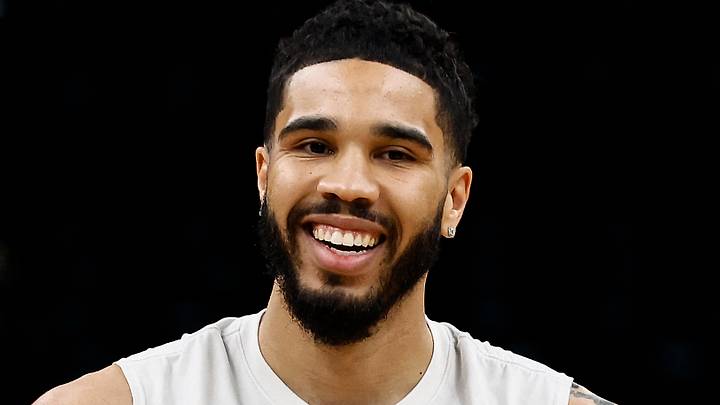
Whether it was fair or true isn’t really the point, but for several years now, the Boston Celtics have been operating as if they have two superstars in Jayson Tatum and Jaylen Brown. Tatum has been the better player in almost every meaningful way, but the two have almost evenly split usage and production with only a slim gap, representing more of a 1a/1b dynamic than a true number one and number two option.
The trade of Jaylen Brown for Paul George signifies the end of that situation, though, and helps in part further explain the rationale behind the trade. The 1a/1b thing had run its course. Tatum has earned the status of a true number one, and the Celtics believe that they’ll be better off empowering him to operate in that fashion with a complementary supporting cast instead of a co-star.
George is not as good as JB, at least in terms of being a number one, but he knows his role and will happily play the Robin to JT’s Batman, which is something that the Celtics didn’t think Brown was going to be happy doing. Or, perhaps more importantly, they didn’t think that was an ideal role for his skill set.
George is a sidekick, not a co-star to Tatum
Boston needs the role-player type of skills around Tatum, like spot-up shooting, which George excels at. Brown can be a beast with the ball in his hands, but when he’s off the ball, his impact is certainly diminished. Maybe he wasn’t going to be happy playing off the ball and taking a backseat to Tatum, or maybe Brad Stevens just didn’t want him doing that, and he certainly didn’t want to pay him 35% of the salary cap to do that.
The exact breakdown of that whole issue remains unclear, but what is clear is that they want Tatum to function as the team’s alpha on offense, and everyone else to be playing off of him. They felt that while Brown was an able first option, giving him so much usage meant taking away from Tatum, which has just proven to be a losing equation over the course of both players’ careers.
Jayson Tatum is the Celtics' unquestioned alpha
Now, there’s nobody to get in Tatum’s way, and there’s no question about who the offense is running through on every possession. That’s not to say that Jayson is going to start playing a Luka Doncic-like heliocentric offense where he pounds the air out of the ball and either shoots or sets up a shot at the last second, but he’s going to be the fulcrum of most sets.
And when he’s not, there will no longer be any semblance of ‘your turn, my turn’ situation with another star, it will be secondary creation and second-side actions from George, Payton Pritchard, Derrick White, and others to spell Tatum, divert the defense, and target mismatches and advantages.
It has always been a winning strategy for the Celtics in the past, and they haven’t missed a beat whenever Brown has been out of the lineup or on the bench. They’re betting that extrapolating that out over a much larger sample size and adding a better-fitting sidekick will yield even better results, and that’s what everybody is waiting to find out. This season can’t start soon enough.
 Add us as a preferred source on Google