

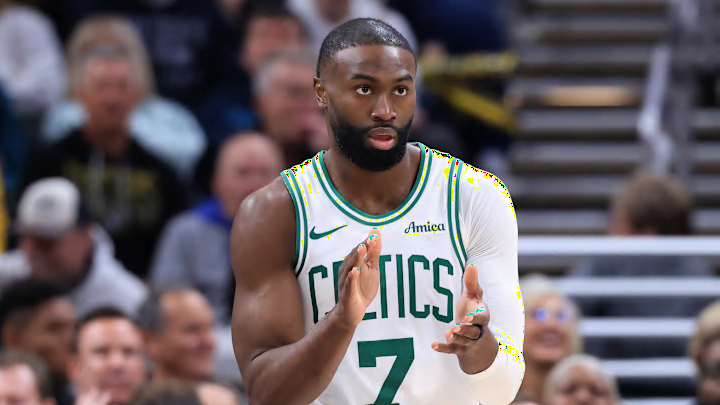
Joe Mazzulla and Brad Stevens have helped the Boston Celtics epitomize the modern style of basketball. With multiple ball-dominant wings, positionally undefined guards, and bigs who never truly fit the traditional archetype, Boston won a championship, made two NBA Finals appearances, and turned the Conference Finals into a second home.
With multiple All-Stars departing over the summer and Jayson Tatum still sidelined by a ruptured Achilles tendon, however, it's old school basketball that's saving Boston's season.
The Celtics traded Jrue Holiday and Kristaps Porzingis, lost Tatum to the aforementioned injury during the 2025 NBA Playoffs, and let Al Horford walk in free agency. Rather than immediately replacing the departed players with proven veterans, Boston tasked its coaching staff with finding a way around the widespread losses.
Mazzulla has responded by catering his strategy to the strengths and weaknesses of his players, as so many great strategists have found a way to do.
The results have been remarkable, as Boston has jumped out to a 20-12 record despite losing four high-level starters. Jaylen Brown has led the way with a season that should have him in MVP discussions, and Mazzulla has perfectly positioned the superstar to play his preferred style.
By embracing the midrange jump shot at a time when it's been largely devalued, the Celtics have managed to stabilize what appeared to be a sinking ship.
Celtics embracing midrange jump shots as stabilizing forces
Boston finished the 2024-25 season ranked No. 21 in the NBA in percentage of points scored via midrange jump shots. It was also No. 21 in 2023-24, finished at No. 27 in 2022-23, and narrowly cracked the top 20 at No. 19 in 2021-22.
Fast forward to 2025-26 and the Celtics rank No. 2 in the NBA in percentage of point scored via midrange jump shots.
In the event that the Celtics finish the season in the top 10, it would be the first time they've done so since 2018-19. Considering the minimal emphasis they placed on the midrange game as recently as last season, this is nothing short of a drastic change.
Jaylen Brown has been at the forefront of that ideological shift, as the best individual season of his career coincides with his ranking No. 9 in the NBA in percentage of points via midrange.
Brown is burying 3.0 midrange jump shots per game on 49.7 percent shooting as the Celtics near the midway point of the 2025-26 season. He's also attempted more midrange shots (173) than he has three-point shots (165).
At 29.5 points per game on .505/.370/.778 shooting on a winning team, not even the most staunch of midrange detractors can argue against Brown's old school strategy.
Brown isn't the only player excelling in that regard, as the Celtics' erratic three-point shooting has been balanced out by the midrange J. Anfernee Simons, Derrick White, and Payton Pritchard are all scoring at least 10.0 percent of their points from midrange in 2025-26.
That's a rather shocking development when one considers that Pritchard scored just 4.2 percent of his points from midrange in 2024-25 and White was even lower at 3.7.
With the three-ball falling with far less consistency than the Celtics are accustomed to, however, an old school strategy has saved their season. It's a wise approach, as Boston is No. 2 in the NBA in field goal percentage from both 10-to-14 feet and 15-to-19 feet, as well as No. 8 from 20-to-24 feet.
It may not be the strategy that the average fan would suggest enlisting in the modern era, but the Celtics are allowing adaptability to guide them to success.
 Add us as a preferred source on Google