

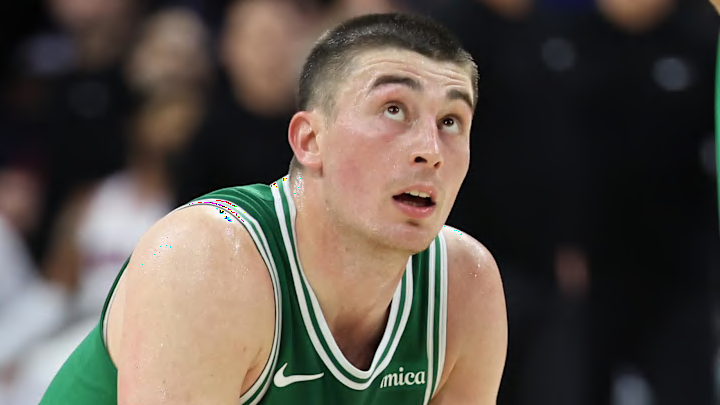
Joe Mazzulla called a timeout with 10:24 remaining in the fourth quarter of Thursday’s ugly Game 6 loss. Down 23 points, Jaylen Brown and Neemias Queta headed to the bench where they’d remain for the rest of the night. Every Boston Celtics rotation player, minus Payton Pritchard, had played their final stint.
In less than three minutes, the Philadelphia 76ers’ lead was cut to just 12 when Luka Garza slammed home a dunk to bring the Celtics’ run to 11-0.
You read that right.
The Celtics pulled their starters and things got better.
Pritchard, Garza, Baylor Scheierman, Jordan Walsh, and Ron Harper Jr., played Thursday’s closest brand of basketball to what fans grew accustomed to watching all season long.
All of a sudden they were getting stops, grabbing offensive rebounds, creating and making clean looks. They looked like the Celtics.
“I think anytime you sub in a lineup like that, you catch the other team off guard, and they probably took their foot off the gas a little bit,” Joe Mazzulla said. “But, I thought our guys played hard. We got some offensive rebounds. We were losing the shot margin up until that point. I think those guys got the shot margin back [by creating] a couple turnovers and some offensive rebounds.”
The Celtics' stars have to learn from the reserves to give them any hope of moving on
A less-talented group of players than the one that Boston leaned on as they limped through the first three quarters gave them some semblance of life. Not quite life, but maybe like when a corpse flinches due to rigor mortis.
The game, unfortunately, was still over.
Still, the starters could still learn a thing or two from what went well. Payton and the boys were, in fact, playing against Philly’s regulars. Not only did they show the most fight of the evening, but they did it after having hardly played to that point.
“Yeah, I mean, give those guys credit,” Jayson Tatum said postgame. “Obviously, it's tough being in that situation where you didn’t play for three and a half quarters and then to produce the way they did. They just had a good pop about ‘em, played with good pace, and got back to playing Celtic basketball. I think it was inspiring to the starting group, and we need to get back to playing how we’re accustomed to.”
Pritchard, the only player who had seen more than seven minutes prior to the early fourth quarter, pointed to pace as the element that changed the most when the stay-ready crew took the floor.
“Just we got to play fast,” he said of what the team can take from their lone successful stretch in Game 6. “We’ve got to get up and down and play with a lot of pace. So that's what we do [going forward].”
Whether or not “pace” directly meant flying up and down the floor, or just playing a fluid style of offense wasn’t clear (as the Celtics ranked last in pace all season and still had plenty of success). Their offense, however, did look more active. Guys were moving without the basketball. The basketball was moving. When shots hit the rim they didn’t always find the 76ers’ hands, Boston actually grabbed offensive rebounds -- of which they grabbed one in the first half.
The game was simple for them.
As dumb as it may sound, they weren’t overthinking things and relentlessly attacking so-called mismatches. They just played basketball the best way they knew how -- with effort.
“They just play harder,” Brown praised. “That group came out. They wouldn’t have cut into the lead if they didn’t play hard as a group. Before that, we didn't play hard.”
Whether it was Garza sprinting the floor at any opportunity, Harper Jr. slapping out an offensive rebound to create an extra possession, or three Celtics crashing the defensive glass to prevent Joel Embiid from an easy putback layup the difference in effort was jarring.
If the Celtics have any hope of avoiding becoming the 14th team in league history to blow a 3-1 series lead, the stars are going to have to learn from their understudies.
 Add us as a preferred source on Google