

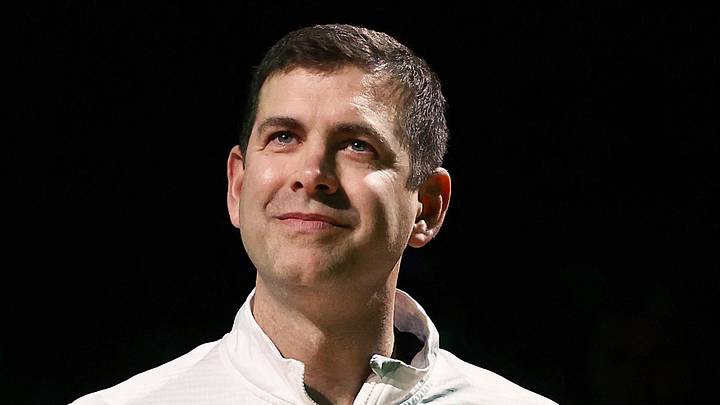
It's been five years since Brad Stevens took over as the president of basketball operations for the Boston Celtics. It's fair to say that half a decade into his tenure, he's done an exceptional job. Yeah, some of his decisions have been heavily criticized this offseason, but we don't know how those will work out, and it doesn't erase the work he's done.
Everyone knows about the home run moves he's made, but there have been some decisions he's made that haven't gotten as much credit as they deserve. With that said, there needs to be some clarification what fits the bill as underrated.
For obvious reasons, we're excluding Stevens' best moves because best and underrated are clearly not the same thing. From bringing Al Horford back to acquiring Malcolm Brogdon, the big names Stevens has brought to Boston while in their primes won't count.
We also won't count any of his draft picks, and we're not counting almost all of the players that he picked up off the scrap heap that blossomed over time, from Sam Hauser to Ron Harper Jr. We're also excluding the time when they traded Kristaps Porzingis and Jrue Holiday because everyone and their mother knew that was going to happen well before they did as well as why they did it.
And don't worry, we're not venturing into the absolutely far-fetched, like signing Joe Johnson to a 10-day contract. That was a nice sentimental story, but affected absolutely nothing.
For the record, under an umbrella like this, it's pretty hard to compare their individual impacts, so the best way to handle this is to go in the order they happened rather than rank them.
Acquiring Josh Richardson
No one exactly knew what to make of Stevens as an executive. After acquiring Horford, many questioned why he used what was left of the Gordon Hayward trade exception on Richardson, who had come off a disastrous season in Dallas. The questions only amplified after Stevens then extended Richardson an additional year.
Richardson exceeded expectations in Boston, primarily because he was shooting the best he had ever shot from three, on top of his quality individual defense. He wasn't spectacular, but following that team's iffy start, it was a welcome twist to see him play better than expected.
Most importantly, acquiring him led to the Derrick White trade. We all know what happened after that. Because of Richardson, one of Stevens' very best trades would never have happened in the first place.
Trading Tristan Thompson
When Stevens took over the front office, he had to clean house after a frustratingly mediocre season. He started that immediately when he traded Kemba Walker for Horford. Among the players many thought would be the hardest to get rid of was Tristan Thompson.
Thompson was a free agency bust for Boston, but worse, he appeared to be a bit of a cancer in the locker room. There was intel suggesting he was a problem for the Celtics. Even though some teammates tried to shut that down, it never quite canceled the noise altogether.
Once they brought Horford back, it made Thompson look all the more expendable, which was going to be hard after he didn't pan out. That's why it was pretty impressive that Stevens found a taker for Thompson in Sacramento. There's no telling if Boston would have kept him on the roster or just straight up ate his salary while waiving him.
Letting Evan Fournier walk
Fournier also didn't exactly pan out for the Celtics, but that situation was rather grayer than Thompson. He got COVID just as he got traded to Boston, then played for a team whose hope had run out not too long after they got him.
The consensus was to re-sign him as long as it was at a fair price. Well, New York gave him a deal Stevens wasn't willing to match. However, acquiring Richardson pretty much confirmed Fournier wasn't coming back, and the Knicks soon learned that what they paid Fournier wasn't just a bad idea, but a complete disaster. Not only was he overpaid, but he swiftly declined.
If the Celtics had relented, their cap situation could have gone very differently: White may never have joined them if they had paid to keep Fournier, and/or they never would have had the flexibility to add Brogdon the following summer.
Signing Malik Fitts, Juwan Morgan & Nik Stauskas
Stevens made some seismic changes at the 2022 trade deadline, bringing in White and bringing back Daniel Theis. He also had quite a few roster spots to fill, which he did with Hauser and Luke Kornet, but opted to fill the final roster spots with Fitts, Morgan, and Stauskas, despite the little value they had.
But why? Well, we found out the following summer. All three of these players were used as cap filler in the Malcolm Brogdon trade. It's the little things like those that make him so good at his job. Plus, even if those three brought nothing to Boston on the court, Fitts had some iconic celebrations on the bench.
Okay, so Stevens executed a strategy like this multiple times. Using players he signed or traded for to get a bigger fish down the line. He did it with Richardson as well as Dennis Schroder, Enes Freedom, Daniel Theis, Danilo Gallinari, and Mike Muscala. So, why aren't they getting mentioned here?
Well, because, one, repeating what was already said with Richardson feels like a time waster, two, Richardson was the best example of this, and three, the sextet of Richardson, Schroder, Freedom, Theis, Gallinari, and Muscala were all brought in to make the Celtics better with their skillsets. The trio of Fitts, Stauskas, and Morgan were brought in strictly to get someone like Brogdon.
Not panic-signing Carmelo Anthony
Gallinari was supposed to be Boston's prized free agent acquisition of the 2022 offseason, but they never got to see it because he tore his ACL just before training camp. When that happened, many wondered what Boston would do to fill the role Gallinari was supposed to play.
The first instinct was Carmelo Anthony, as Gallinari was supposed to be their wing scorer off the bench, and Anthony had done that for the past few years. In fact, there was intel suggesting that Boston was considering it. However, they never pulled the trigger because they believed Hauser could fill in for Gallinari.
Hauser is not the same player Gallinari was, but his three-point shooting did about as good a job as the Celtics could have hoped. It's not like Anthony wasn't a quality scorer anymore, but his defensive shortcomings would have been too easy to exploit for opponents. That was not a problem with Hauser, and he proved the Celtics were right to trust him over Melo.
Signing Blake Griffin
Okay, we're cheating a little bit, and Griffin has been brought up multiple times. So, without repeating ourselves, the Celtics brought in Griffin at the last second as part of their efforts to give them emergency depth when they had to rest Al Horford and Robert Williams III.
Griffin wasn't a star anymore, but he gradually became excellent as a fill-in starter that Boston didn't skip much of a beat with him. In fact, when he started at center for the Celtics, they went 13-3. He didn't drive that, but he was not a detriment for what they were trying to do.
More than that though, Griffin was a great influence in the locker room. When Payton Pritchard struggled with his subsidized role, it was Griffin who was was able to comfort him. There's no telling what would have happened with Pritchard if Blake had never been there. For someone who was a shell of himself, Griffin proved Stevens could find vital contributors from the least likely of places.
Letting Grant Williams walk
Remember how keeping Fournier was a divisive subject back in 2021? Well, Williams was that times 10. Williams had stretches where he looked like a staple of Celtics basketball, but he also had stretches where he should have been in the G League.
After his best season in Boston under Ime Udoka, Williams put the "mixed" in "mixed bag" in his lone year under Joe Mazzulla. At first, it looked like re-signing him was a no-brainer, but the mental hurdles of a contract year got to Williams, leading to poor decision-making that got so bad that Mazzulla had to bench him.
Williams eventually got his spot back, but keeping him was far from a straightforward decision. it was easy to see the glass as both half-full and half-empty. It was clear Stevens saw it as half-empty, as they signed and traded him to Dallas.
GIven Stevens' efforts to save money for Boston, keeping Williams would have been a risky idea. Maybe there would have been teams interested in him, but it's also possible it would have cost Stevens some first round draft capital.
Since then, Williams was traded halfway into his lone year with the Mavericks and has been an okay player at best in Charlotte. With the Celtics winning Banner 18, no one has really looked at what happened with Williams and said, "Yeah, Stevens screwed that one up," at any time for the past three years.
Trading for Xavier Tillman
This is perhaps the only deal here that started and ended with the player involved. Boston acquired Tillman to get some more depth with Kristaps Porzingis and Al Horford. Tillman wasn't supposed to be a game-changer, and he never truly was.
However, he'll still be remembered for his contributions to Banner 18. When Porzinzgis went down early, Boston had to depend on Kornet and Tillman. Amazingly, they proved to be matchup-dependent. While Kornet's contributions were more useful against Cleveland, Tillman was better against Indiana and Dallas.
Plus, everyone remembers "the three" and always will.
That was as far as it went, though. After Tillman's knee surgery that very offseason, Tillman was no longer that player. Boston kept him around for his veteran influence until they had to save some money.
Every championship team needed a contribution from the least likely of players. Because Tillman did that, acquiring him fits as an underrated Stevens decision.
Trading Georges Niang
Again, we're cheating just a tad because he was traded for the exact same reason Porzingis and Holiday were. However, no one knew if trading him was the plan in Boston before Stevens did it.
Niang was a little superfluous with Hauser on the team, but there are worse fates than having two sharpshooting wings. However, Niang's time in Boston proved to be short lived, as they traded him in basically a salary dump to Utah.
However, it turned out to age better than everyone thought. Not that anyone was rooting for this, but Niang didn't play a game last season because of a stress injury in his foot. Boston got to get even closer to the NBA's first tax apron for someone who wouldn't have played a game.
It was already smart enough for Stevens to cut costs, but trading Niang aged like wine, much like the rest of the moves he's made on this list.
 Add us as a preferred source on Google